London

Southwark Town Hall

Andy Costa

Architect
Southwark Town Hall

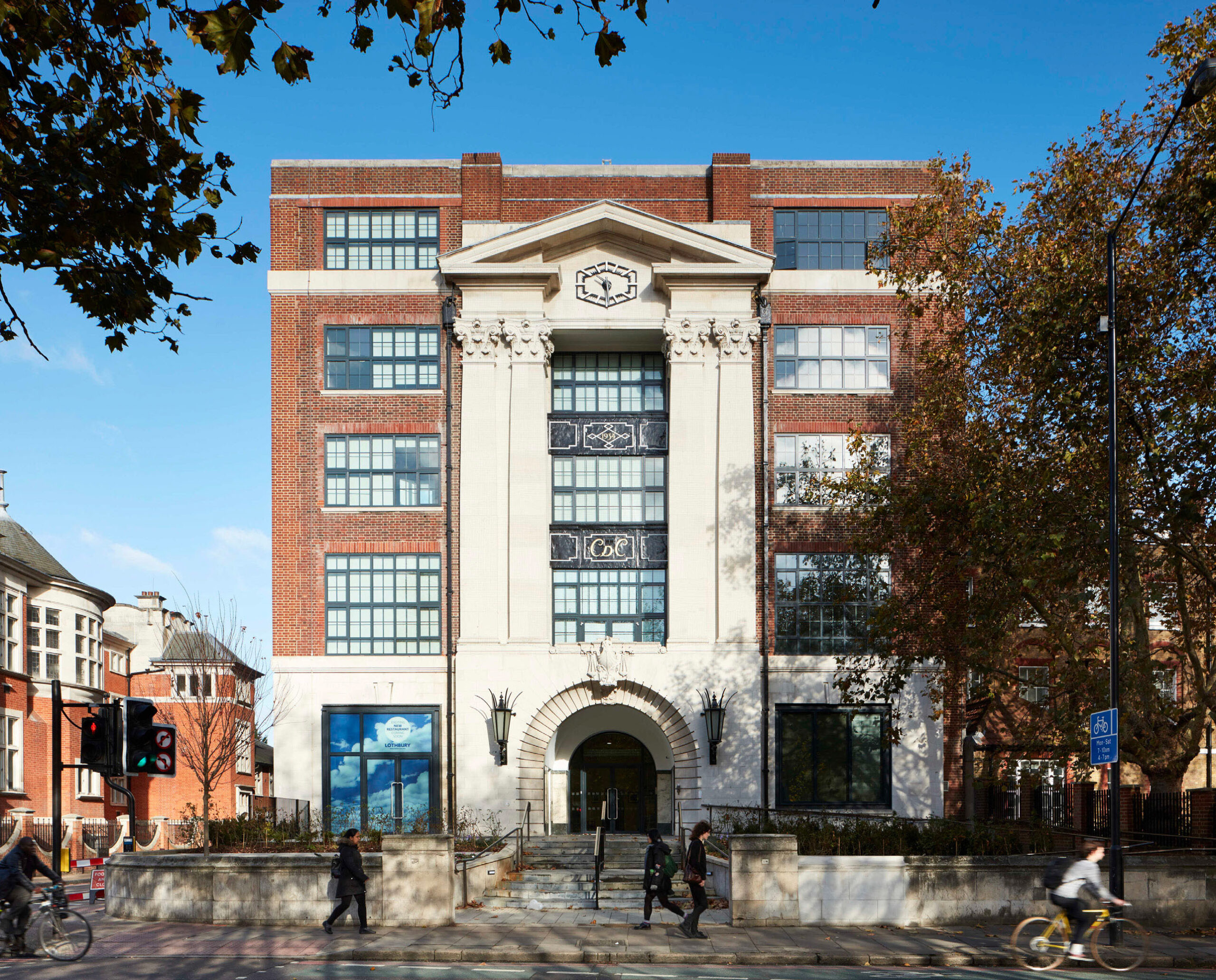
The brief by Alumno Developments was to regenerate the site of the former Southwark Town Hall as a mixed-use building which includes the new Theatre Peckham, accommodation for Goldsmiths College students, the new Theatre Peckham, Artists studios for ‘Space Studio’s’ and a Community Cafe/bar, restaurant and gallery.

One benefit of having such a strong and rich brief is that you can really work on the narrative of the building and think about how that expressiveness manifests itself, in order to make both the student and community experience much more holistic.

Since my own student days and throughout my architecture career, I’ve been interested in exploring narratives in design, thinking very much about the way that buildings, through their physicality, can convey an element of surprise or experience or joy.

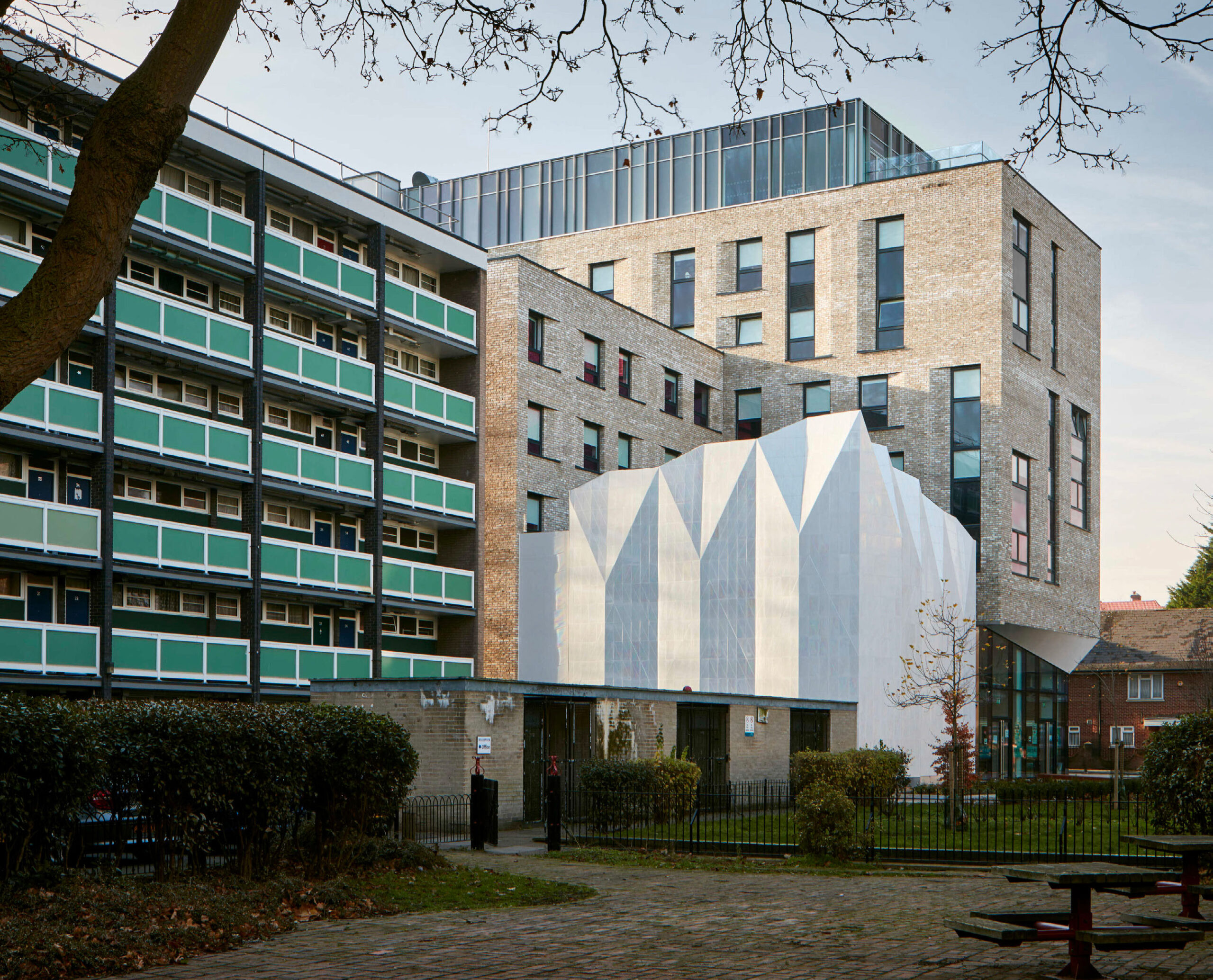
There were layers to the original building just as there had been layers of different users over time. There was the original 1870’s vestry hall, with the 1950’s Town Hall architecture essentially enveloping this original building, and adjacent Georgian houses providing a rich historic context. There is a real connection with the way that the surrounding area builds in time and, rather than try and make it homogenise, we felt that each element could be expressed and stand on its own merit. I thought about how any new elements could be constructed against this backdrop of heritage while fitting with the values of the local community and we worked closely with the planning team to develop a complementary, contemporary response. The idea was to really create something of its time and of the moment, so that it would become another layer of pantheist, another layer of memory of the building
reflecting its enduring vitality.

The scheme was designed to include private student gardens, generous common spaces and lounges. The new extension made use of insitu slab with pale bricks complementing the hall’s Portland stone and weathered brick, tying the new and historic together. We had some fantastic essential uses proposed in the early stag- es of the scheme. These were testament to the strong ethos that Alumno shared with Jestico and Whiles, to engage both Art and Architecture and promote them together. We were really very lucky that these evolving and changing ideas were something that manifested right through the physical element of the building.

London Southwark Town Hall

The building is topped by a sky lounge with magnificent views across London, providing social space. The roof-top pavilion is enhanced with coloured glass which creates interesting shadows and reflections. At ground level twelve self-contained artist studios are provided to nurture emerging talent, augmented by an independently-operated public gallery and café. When we were designing the layouts we allowed the building to tell us where to divide it up and didn’t really force sub division behind the facade which felt unnatural. We had a great opportunity of both height and volume in the rooms driven by columns within the building. We allowed the existing building to guide us in its own reinvention as it has a sort of life of it’s own and informs you as to how it can be re used. As far as the actual student rooms are concerned, there are many stunning big rooms where you still feel you’re in quite a grand mid 20th century building, though with modern pod style bathrooms – appropriately in keeping with the quality of experience we wanted for the students. Within the old building there was a repository of plans and safes which contained decades worth of symbols and emblems, for example crickets sets that had been given out as awards. We were able to salvage quite a lot of this visual data. This ensured we could keep some of the old Town Hall alive for
local people who would have memories of it.

‘The idea was to really create something of its time and of the moment, so that it would become another layer of pantheist, another layer of memory of the building’.

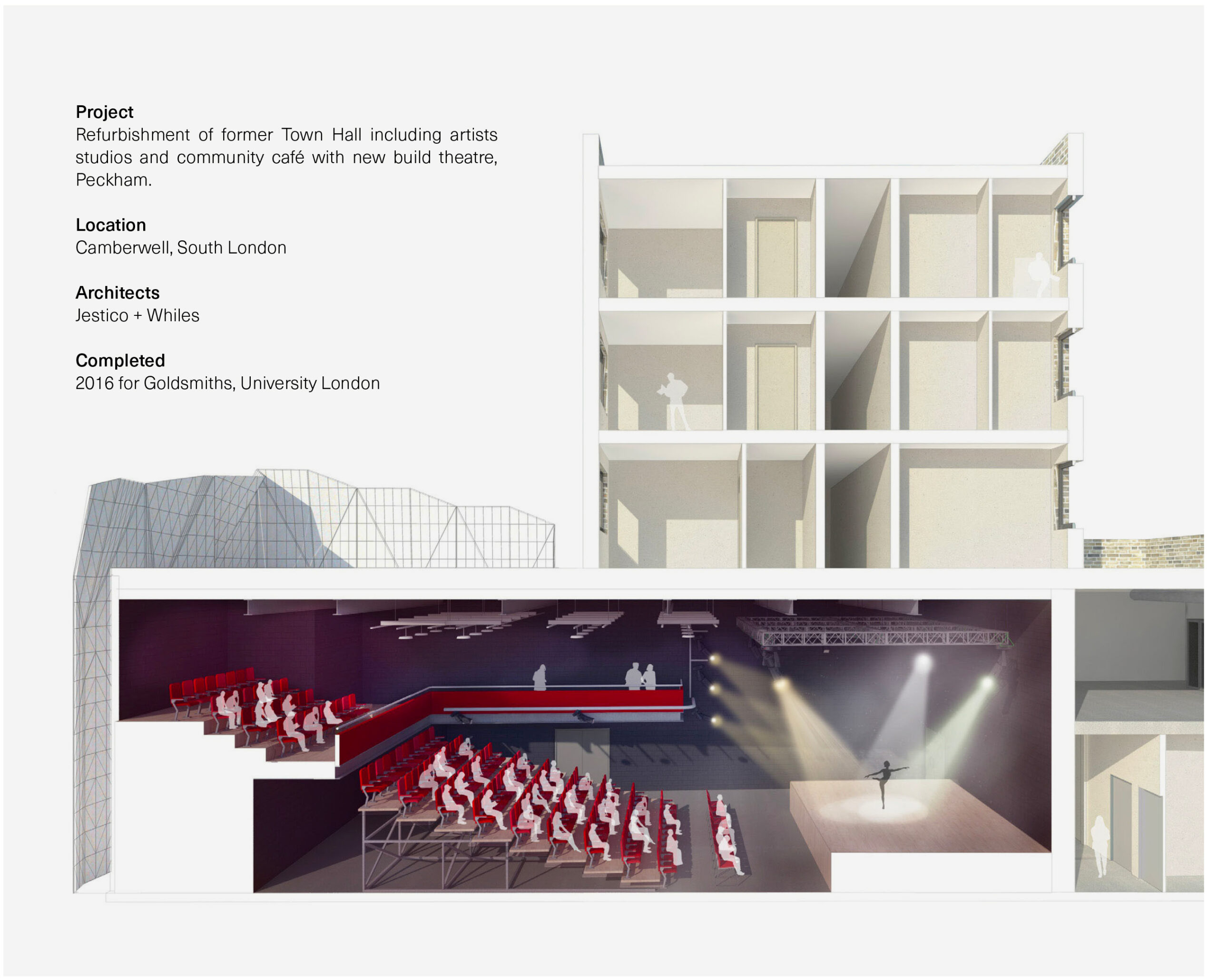
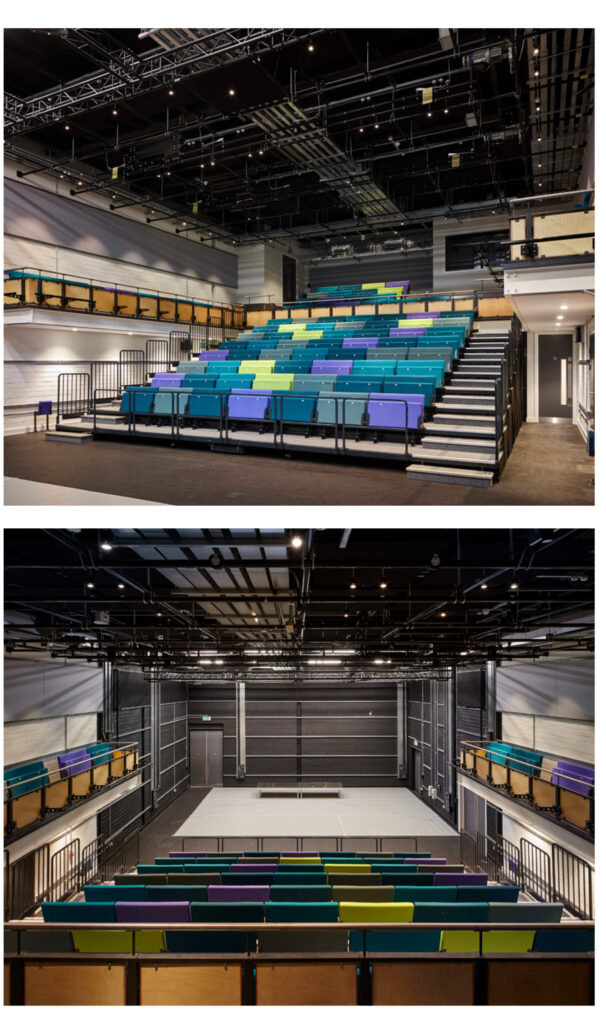
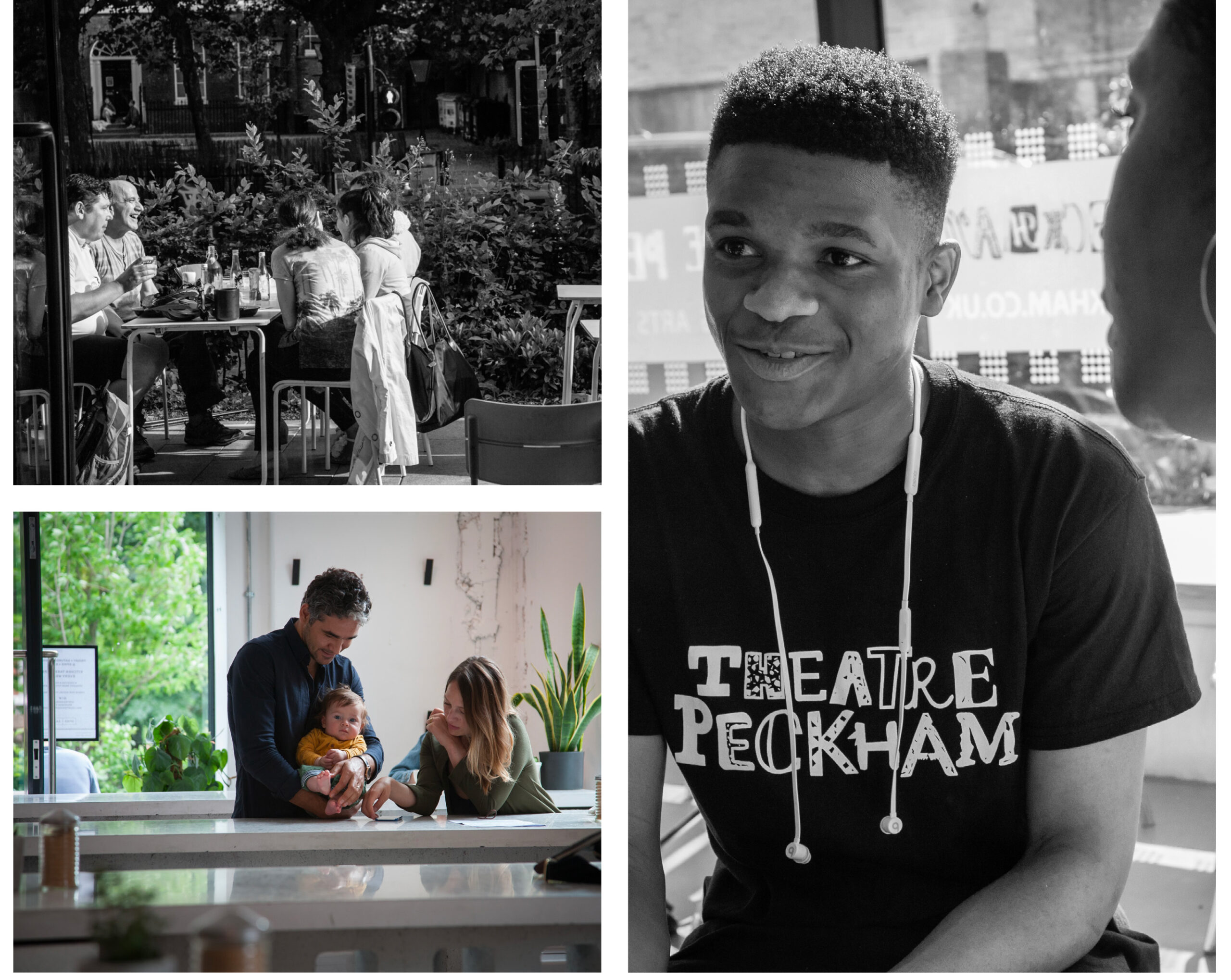
Part of the development involved reconstructing Theatre Peckham – a community theatre housed in an adjoining badly run-down community hall on the site. The goal was to create a state-of-the-art studio theatre complex with 200- seat auditorium, rehearsal space and dance studios – all under one roof – with a foyer and breakout space accessed from a new public piazza to the north.

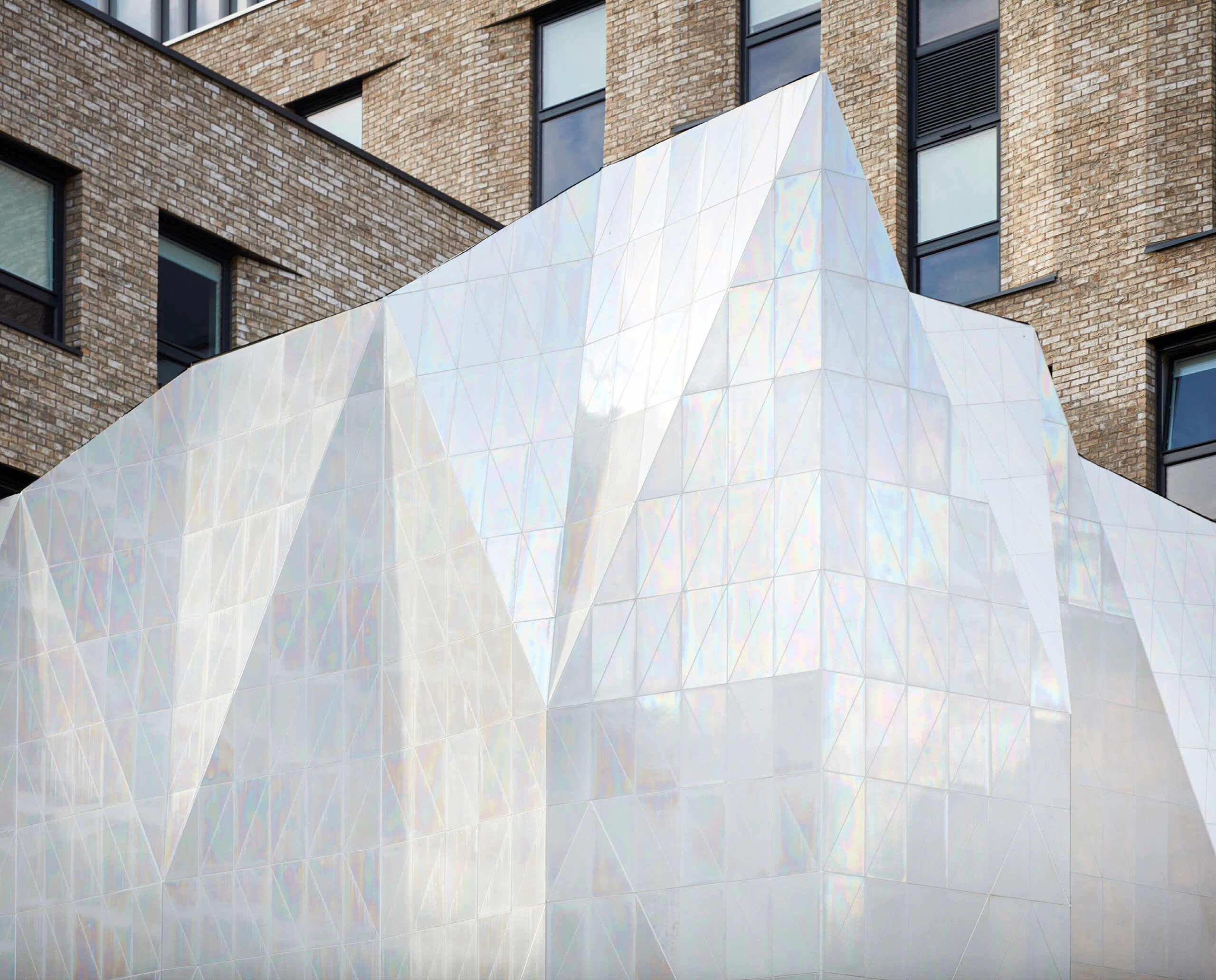
I had been particularly inspired by a project in Spain in which a beautiful but simple ceramic tiled box was placed in a naturalistic landscape, reflecting the sky and the moods of the different seasons. The iridescent whites of these tiles had a lot of dynamism within them which I thought would add a

richness to the auditorium, situated at the back of the theatre. As this is also to the front of the residential housing estate, we wanted something that was vibrant and ever changing in different forms of light.

I was drawn to the personality of these tiles by my own early experiences of theatre. As a young person I recall the feeling of anticipation and excitement when the red velvet curtains were just about to be drawn. I wanted to re-create that sense of “what’s going to happen” by creating a tiled interpretation of this. Although the tiles were originally manufactured as a one off, the Spanish architect agreed to oversee a run of them. We used specialist software to calculate the geometries needed for the irregular and dynamic patterns and worked in conjunction with Alumno to resolve classic supply chain issues such as what would happen if tiles were to break. Alumno were fully invested in the vision Jestico and Whiles had for this and it’s very much liked by the local residents.

We worked with the theatre from the outset. A very enjoyable process where we communicated some of our ideas. The children contributed their opinions and I have dozens of post it notes with children saying this is the best thing ever. Lets just do it now. Its a fantastic idea. So very heart warming how local users responded to the initial idea and the develpoment of the theatre. I’ve subsequently been back and spoken to Theresa Early, who founded the Theatre, and she’s been very positive with feedback on the appearance of the building. It feels like it belongs to the community which I think is something to be proud of and testament to the support that we had as designers from Alumno. I think the common human factor, of excitement, is something we all share regardless of how fortunate we are, what we were born into or how much income we have. I think the ability to create a space that is all inclusive and belongs to the people is absolutely something that humbles you when you see it actually in use by the local community.

Although I wasn’t involved in the construction element of the project (which was undertaken by Jude Harris) I’ve kept up to date with it and regularly go back to talk to local people. I actually just enjoy sitting there watching people going in and out of the building and experiencing it. The ethos and spirit which Jestico and Whiles brought to the project continued right the way through so essentially anyone involved on the project was equally responsible for it. The project was finessed and completed very well.

Overall this eclectic mix of uses really makes the building, and Alumno’s fore- sight to be more than just a student housing developer has really enriched the scheme and made it the success it has become

Jude Harris

Architect
Southwark Town Hall

I joined the project in January 2015, and shadowed my colleague Andy Costa who left the business in March 2015. Andy had worked on the project in the early stages and worked with Alumno to develop the brief and secure planning permission. At the time I joined the project Alumno were working with their construction collaborators H G Construction, who also played a key role in delivering a quality building and working with us to protect the important heritage features of the original town hall building.

The planning officers were very supportive of the project throughout, and in particular Michael Tsoukaris helped us to protect the original qualities of the
scheme and realise the ambitions with the new public plaza and the bold contemporary theatre aesthetic.

One of the most striking features of the development is the Sky Room – a student living room with magnificent views over London. This space adds real value to the building and also brings the local community into the building as it is let out for special functions.

Jestico + Wiles really enjoyed working with Alumno and it was great having a client with the foresight and appetite to take on such a difficult project and to challenge conventions. The planning process of preserving a heritage building and the community theatre on the site made the project complicated enough, but a further rich mix added additional activity to the
building in the form of the café gallery and the artists studios which make the building such a success.

It is great to receive such positive feedback from the multiple users of the building and to see the contribution that it has made to the locality in Camberwell.

London Southwark Town Hall

Theresa Early

Founder and Artistic Director
Peckham Theatre

Theresa Early is the founder and artistic director of Peckham Theatre, which focuses on providing training opportunities to young people living in London and has patrons including highly acclaimed actors Sir Ian McKellen, David Harewood and John Boyega

‘As a graduate of the company, I admire Theatre Peckham’s continued mission to increase diversity in the creative industries, inspiring young people like myself to be the change we want to see in this industry’.

Our old venue had always been quite rough, but we looked after it as well as we could, for as long as we could, until it was in just too bad a state. I remember during a hard winter, this production we put on had a big tropical set and snow was falling down on it because the roof leaked so badly

I met David Campbell while he was considering what to do with the area at the back, when redeveloping the Old Town Hall, and I said “we want it”. I explained why and he agreed. It was a huge commitment and a big challenge to get it right, but we got there and it’s working very well. He would be proud if he could see all the good it’s doing. It’s so important to have this place. It really means something to a highly diverse community, to be able to go through here and end up in mainstream theatre or in film. We actually have people all over the creative industries. Take our current alumni for example; two of them are writing books, one is converting one of her books into a play right here, a piece of children’s touring theatre. We have graphic artists, we have designers, we have administrators, we have people who are producing.

Anita Graham

Parent and ex student
Peckham Theatre

I was painfully shy as a child, but Peckham Theatre helped me so much. Now my daughter is here, loving it and blossoming. She’s done two productions already and she’s only eight. Theresa remembers me as a five year old, walking through my estate and saying “sorry about the mess” back when things were pretty rough. She was astounded that a five year old would even be worried about something like that, but somehow I was acutely aware.

This place has historically been somewhere that gives kids a real opportunity. Even if they don’t end up working in the performing arts, the discipline, values and experiences instilled from a young age are very important. My daughter could go on to be a public speaker if she wanted to, because she has been on the stage and learned lines and songs. There’s so many different skills you can take from it. Who knows where she is going to go as an adult.

We’ve been given this wonderful new building, which is beneficial to the community as a whole. I believe it still should very much be a place that also supports kids that aren’t privileged, as so many have benefited enormously from this place. There are bursaries, subsidised fees – even the standard fees here are very very competitive. If this changes, it may force some children not to be able to afford to come.

I work in Higher Education with Imperial College London. The confidence Peckham Theatre gave me has helped with my whole life. I think it even helped me in my degree course. I was pretty much put up as a spokesperson for any group work, they were like “oh Anita will do it”. So this girl that could barely speak when she was six is now being put up as a spokesperson.

Theresa is a remarkable woman who has nurtured some great talent and has amazing success stories. When John Boyega was in Star Wars my godson and daughter were in a production here, and so proud that John was initially trained here, that this was where his roots were. Seeing him being catapulted to fame like that, it’s been brilliant, and there are many more out there working in the industry.

London Southwark Town Hall

London Southwark Town Hall

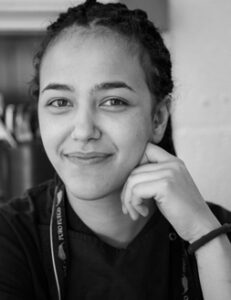
Aneliya Vodkova

Head Chef
Spike and Earl

I’m from Sofia, the capital of Bulgaria, where I trained and began my career before mov- ing to London. I actually dreamed of being a chef since childhood, apart from a brief period when, for some reason, I was convinced I wanted to be a policewoman.

After gaining experience in an Italian restaurant, then a fine dining French restaurant, I thought I was prepared for a more promoted position and so applied to be Head Chef here. I like the way this organisation is run. When I source the food I try and source it ethically, because this is an ethical organisation. I operate a seasonal menu, which also makes the products more sustainable, and thankfully the customers seem to really enjoy the food. There are staff here who have had problems in their lives and I think we all work well together as a team.
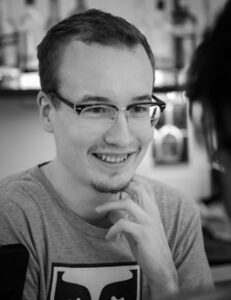
Sebastian Lyche

Head Chef
Spike and Earl

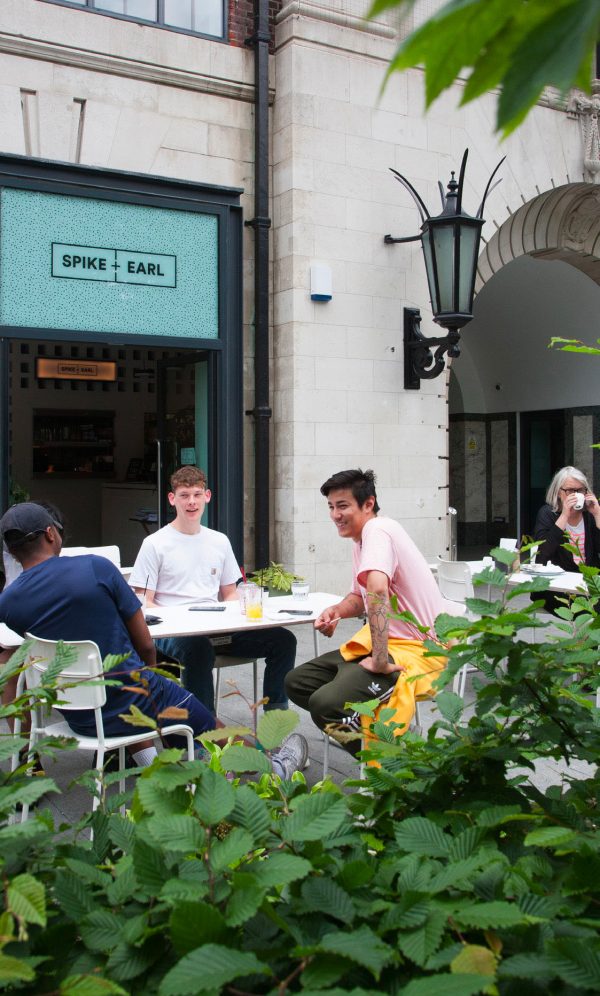
Spike and Earl cafe is part of the regenerated Town Hall building in Camberwell.

I initially moved here from Norway to study Politics at Goldsmiths University, and stayed in the area after I graduated. I’m also looking to work with Old Spike Roastery which is part of the same company. It’s a coffee roastery and a social enterprise. So they buy really high quality coffee beans from all over the world. They pay a good price to the farmers, support sustainable projects and also hire and train homeless people, just as we do here. There’s a political aspect to this company, where everyone can grow and develop – from the suppliers to the employees – so I do feel like my degree is already kind of relevant to what I’m doing
London-Southwark-Town-Hall-9

Adan Abobaker

Chef
Spike and Earl

I was born in London, but we moved around a lot. I actually trained to be a chef in New York. So it’s been quite an unusual life, even finding myself in the midst of civil wars, especially when I went to Somalia to get my Uncle over the border when his life was in danger. There have been times when life was very good. I was happily married before we were hit with some really bad luck, then I started suffering very badly from depression and lost everything.

I came back to London penniless, homeless and lived on the streets for quite a while. I ended up saving a couple of people’s lives and got the Queen’s Gallantry Medal.

Jamal, who’s also one of the owners here, heard about this and wanted to meet me. He offered me a job and helped me get back into the land of the living. His partner Dave, who runs this place, knew I was a wasted talent and gave me the support I needed.

So, as well as working in the kitchen here, I also work with Jamal for Change Please. It’s a non profit organisation. We try to take people off the streets and give them support. If someone tells me this, that or the other, I just say “look I’ve been there, you can talk to me, just take it one step at a time”. I enjoy it but
it’s quite emotionally intense.

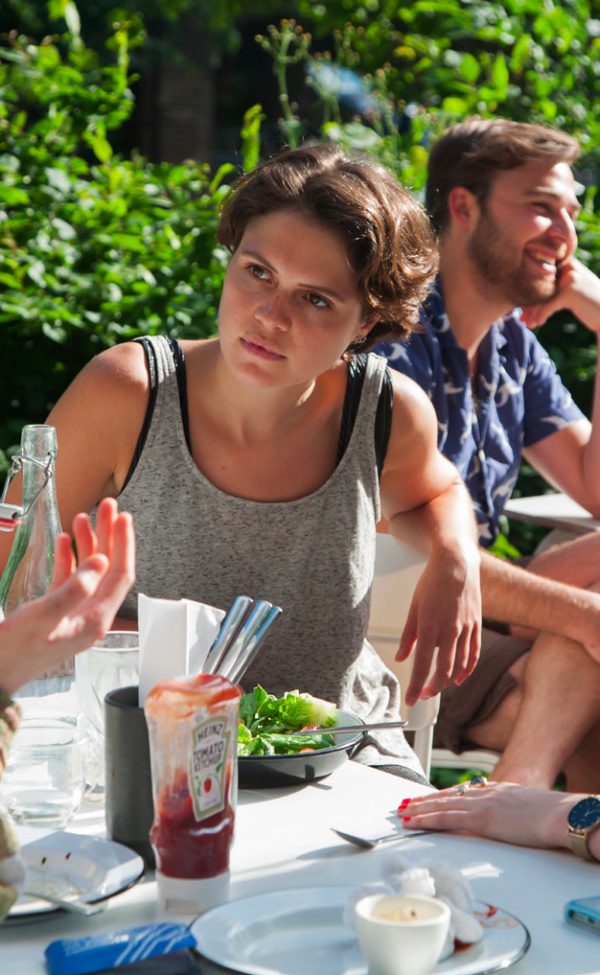
It’s almost like a release for me here. We cater for everyone. You can see students from all over the world mixing with the people who’ve lived here for generations; old people, young people, all types, all together. It’s really lovely for me to feel part of.

London Southwark Town Hall

London-Southwark-Town-Hall-11

Zarah Mughal

Media and Communications Student
Goldsmiths – University of the Arts

I’m from Walton-on-Thames in Surrey, so distance wise I didn’t exactly come very far, compared with many of the students here, but culturally South London a good distance from home! I’m quite culturally diverse anyway, with both parents being immigrants. My Dad is Indian and my Mum Swedish. Walton-on-Thames is a lovely area, and I was fortunate to grow up there, but people reach their twenties and want to experience something different, so it’s wonderful being part of this great buzzy mix. My course at Goldsmiths ticked all the boxes because it was 50% practical, 50% theory, and I wanted that mix. I feel I like to utilise the city that I’m living in, and job opportunities in London are potentially good anyway, so I thought what better place to be than here.

I chose these halls as I was struck by it being such a lovely building, even from the outside. It’s probably the nicest halls I’ve ever encountered. I’ve been to a few of my friends’ ones and this is just so much more impressive. I think we’ve got the best common rooms anywhere and they’re really well used. The top floor one is like a penthouse art space with an amazing view. Everybody goes up there on the rooftop, so it’s great to get to know as many people as possible, rather than just your flatmates. I feel like I at
least know everybody now which is great. So I’ve found that I’ve met the world through the people that I’m meeting here. That’s not something that happened to me at home.

With Media I want to reflect the world, so physically being in and among it is going to help me reflect it, especially within these halls. The whole place feels creative and that’s refreshing to see.

I feel like the experiences you soak up, just as much as the degree itself, are important. I think my course is excellent, but you also need to soak things up outside the lecture hall, and Town Hall really allows me a safe but stimulating environment to go out and explore further.

Veronica Mbugua

Customer Service Advisor

I was born in Nairobi and came to London when I was about six years old. I still speak Kiswahili and the local vernacular for our tribe, as well as English. I began a Law degree, but felt it wasn’t for me, so I took a long gap from university while I worked out what would suit me better. I’m a people person and enjoy customer service. I currently work here part time so am thinking of combining this with further study. The strongest tool we have is our brain, so we should develop that as much as we can. I immediately felt welcomed in this job and the training is excellent, so, if possible, I’d like to continue to be part of the Homes for Students family.

As I’m basically an East London girl, I see a lot of quite big cultural shifts between different parts of London. You find growth in that, wisdom through connecting with different people and an opportunity to develop skills. There are students here from very much everywhere – from China, to America, to only a few miles away.

I’m aware of the importance of trying to encourage actual engagement, and the communal areas here are so successful in that way. Social media has its place but sometimes it’s hard to keep a balance, especially with online peer pressure. Amusingly, when I decided to go off social media for a while some time ago, people were panicking. They were like “are you all right, what’s happening, you’re not posting, what’s going on, are you well, have you gone through a bad relationship, is everything OK?

London Southwark Town Hall

Elizabeth Lefevers

Anthropology Student
Goldsmiths – University of the Arts

I’m from a small town called New Whiteland in Indiana. I studied in Bloomington then moved to Indianapolis, working full time in an after school programme. I really loved it, but the pay was really bad. I had a ton of youth work experience and wanted to professionalise that, to gain a stronger qualification whilst broadening my horizons.

The course here was one of the most unique and exciting programmes I found, in Applied Anthropology. We conduct an actual research project and I’m doing three fieldwork placements, all with organisations that have a community development undercurrent to them.

My friend recommended this accommodation. She had lived here last year and loved it. It’s a beautiful building with real character and history.

I come from a really small Midwest suburban town where you have to drive to do anything. I couldn’t just walk about, soaking up the atmosphere, like I do around Town Hall. It’s a genuinely multicultural, multi-everything area. I’m from a very homogeneous part of Indiana – very white and very middle or lower middle class. So living here is giving me a real insight into people from all walks of life, both within and outside the accommodation. I’m academically working with something and also actually experiencing it.

Coming here has been a worthwhile experience personally and academically. I’m exposed to different ways of thinking, which prompts different discussions.

Some people in the US are a little wary of the outside world because they don’t know very much about it. There are of course people doing really interesting things, even in New Whiteland. There’s just a tendency to be self absorbed and not really look outside when you live in such a huge country. Europeans struggle to get their heads around the sheer scale of it, because even another state is often the same distance away as a completely different part of Europe.
Our sports “World Series” sums it up. People do somehow half believe that it actually means the world. I remember asking my Dad when I was a kid “so are there teams from other countries?” and he was like “no”.

I have become so attached to the UK. The mindset, when it comes to community development and empowering people, seems generally more proactive than reactive – at least in the circles I’m currently exposed to – it’s more about advocacy. I hope I can soak up as much as possible and take that back home. There’s a lot of good about the US as well, but we can all learn from each other.

London-Southwark-Town-Hall-16

Harry Pourdjis

Visual Cultures Student
Goldsmiths – University of the Arts

I was born in North London and raised there till I was about ten, when I was sent to boarding school in Yorkshire. I spent all my school holidays in London till I was about thirteen, when my parents moved to Berlin, but when I came to London to finish off my A levels the memories flooded back and I decided to stay. I had an opportunity to live with family in North London, while at Goldsmiths, but I wanted to feel connected to the culture and community around where I was studying, as well as not having a commute every day. I weighed up all my options regarding halls. Town Hall really stood out to me so luckily I got a place. I love it so much that I want to spend the summer here and stay next year as well. I was so keen to extend, I set my alarm for the moment the applications opened. I literally wanted to be the first person to apply since it’s so sought after.

I’ve made a really good group of friends here and a lot of us want to live here together next year.

There’s a massive terrace on the top floor where you can see the whole of the London skyline. It’s absolutely stunning, especially at night time. The com- mon room itself is really spacious and well appointed. People study there during the day and chill out in the evening. Events are held where people are invited from outside. We’ve had great DJ’s, the lot. There’s a big photographic artwork along one wall, like a mural. Images of the local community are be- low with an interlinking electric buses theme. They are brilliant! You really do feel like part of the community living in this building, especially with the cafe as part of the building.

I originally wanted to study architecture but I developed a particular interest in 19th and early 20th century art, particularly the Pre-Raphaelites and Impres sionists movement, so decided to study Art History. This Goldsmiths course has so far exceeded my expectations. It’s widened my horizons way beyond the areas I was specifically interested in. I’m learning about things that I have never really taken an interest in or even known about and am reanalysing the whole process and surrounding culture. I spent time researching careers I could go into with an Art History degree. The one that really jumped out

London Southwark Town Hall

at me was being an art dealer. It sounds idealistic, but I want – as much as possible – to be a compassionate art dealer, helping less established people develop a more sustainable career out of their art, be it painting, sculpture, photography, whatever.

London-Southwark-Town-Hall-18

London Southwark Town Hall