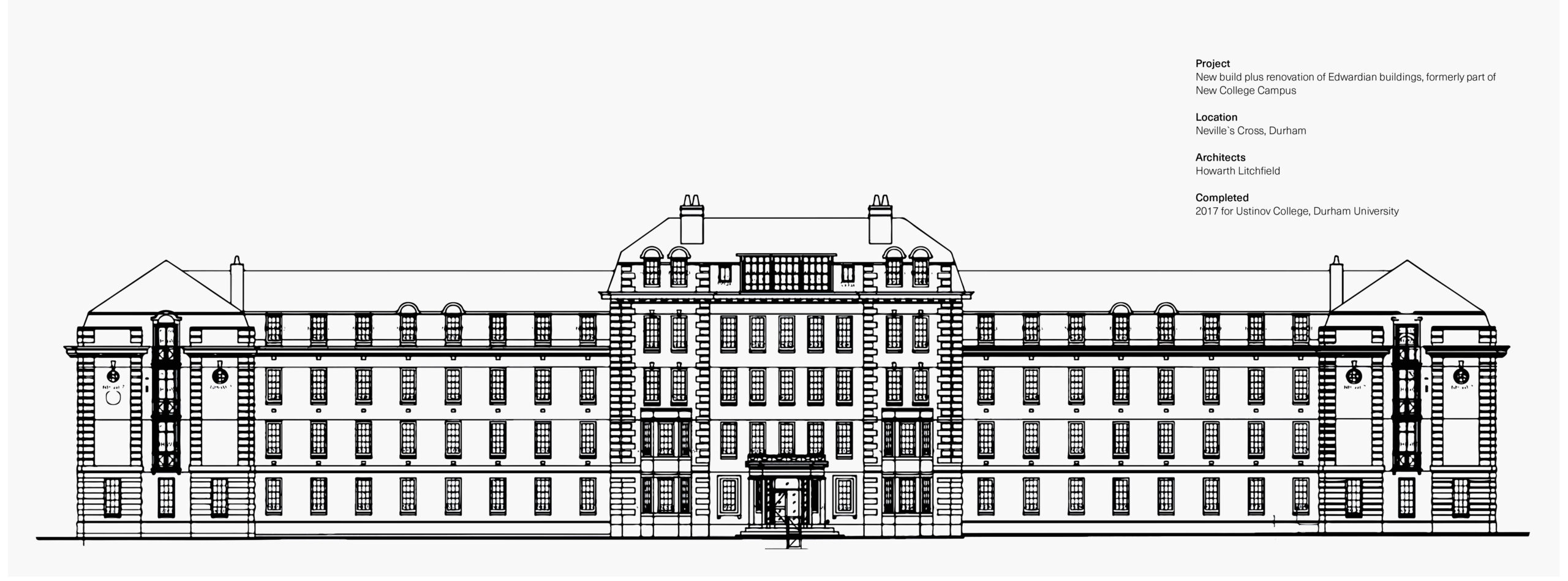
We first met David Campbell and Alumno when we were invited to look at Sheraton Park; a derelict site at Neville’s Cross, Durham, in order to explore how we might transform it and provide contemporary student living. The idea was to somehow breathe life into the heart of the community, creating a place for everyone to enjoy and share, with Ustinov College taking occupation in September 2017.
The three acre site is just over a mile from Durham city centre and had originally been home to Neville’s Cross College – a 1920’s teacher training college. This would later become part of New College Durham, having been owned previously by Durham University for a time. Within the site are two unlisted Edward- ian architectural landmarks; Neville House and Sheraton House, which were in a serious state of dereliction after lying empty for several years. As the site is within a conservation area, the Council had initially determined that both of these important landmarks should be retained.
The site also lies at the heart of a residential development of town houses which presented additional problems, having themselves been partially abandoned in 2007 as the recession took hold. The drawings, hard hats and site calendar all testified how, on a Friday in February, everybody downed tools and the site hoardings were secured for the last time. This is how it remained for several years. The intended luxury apartments partly progressed, with only the base of the large car park being completed. Local residents and Durham County were keen to find a solution to remedy this situation. The site was an eyesore and the white hoardings a bone of contention with local residents.
Like all projects, you are never quite sure at the outset where the journey may lead. It’s all a bit of an adventure, made all the more intriguing by the sensitivities wrapped around student living, and how to harmoniously integrate with the adjacent home owners. Initially there was some resistance, but it was all about collaborative engagement and good design forging the story of how things could be if we all got on board.
Working with Alumno, we developed a proposal to transform these land- marks into purpose-built accommodation for 418 students – an approach which would not only address residents’ concerns, by bringing the buildings back into viable use, but would address a need identified by Durham University for “bespoke student accommodation”.
Durham Sheraton Park
Client engagement and the management of multiple stakeholders were of the utmost importance to the successful progression of this project. It was particularly important to ensure that the plans were fully inclusive and that stakeholders clearly understood the proposals, timescale and implications of the build programme.
The proposals were developed carefully and we openly engaged with all parties, including ward councillors and residents, to fully explore the potential opportunities and constraints of redevelopment. In fact, the development team set up a specific web link to keep the community informed, and pre-planning public consultations were held in the local scout hut.
The consultation stage took two years of negotiation with key stakeholders, including Sheraton Park Residents Association (SPRA) and Durham County Council. The process afforded them ample opportunity to consider and com- ment upon the proposals at each stage of the design. Howarth Litchfield’s role, as a university framework partner, enabled its team to fully understand the significance of the student experience within the collegiate system and immediately engage with the issues to formulate a way forward.
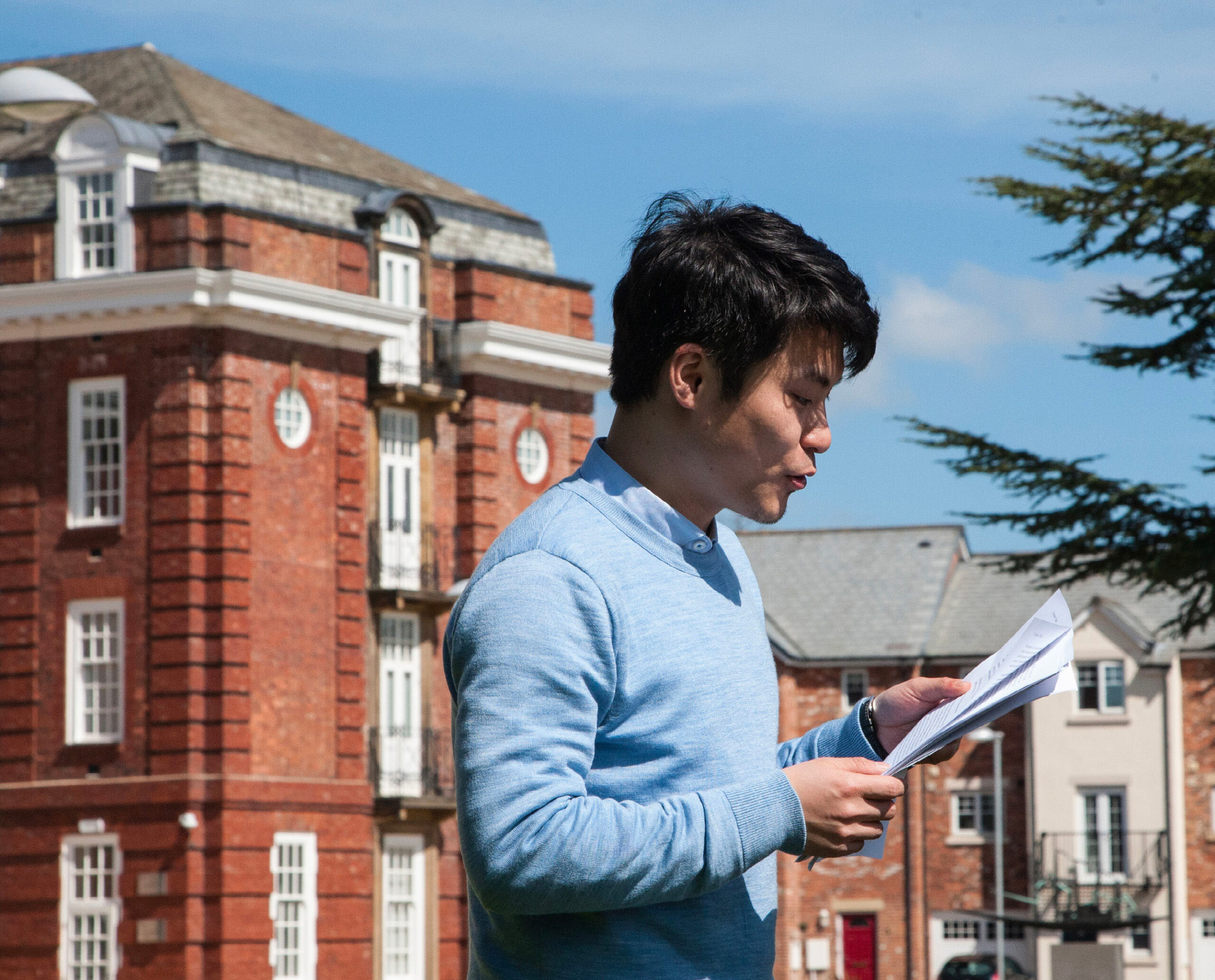
Early engagement with the local community and Council afforded time to convince both that demolition of one of the unlisted heritage assets was in the best interests of regeneration. Through collaborative working with all parties, and an innovative, thorough and consultative approach, the design team were able to demonstrate that the most viable proposal would be to retain, extend and refurbish Neville House – the former residential building – and to demolish and replace Sheraton House, the former teaching block.
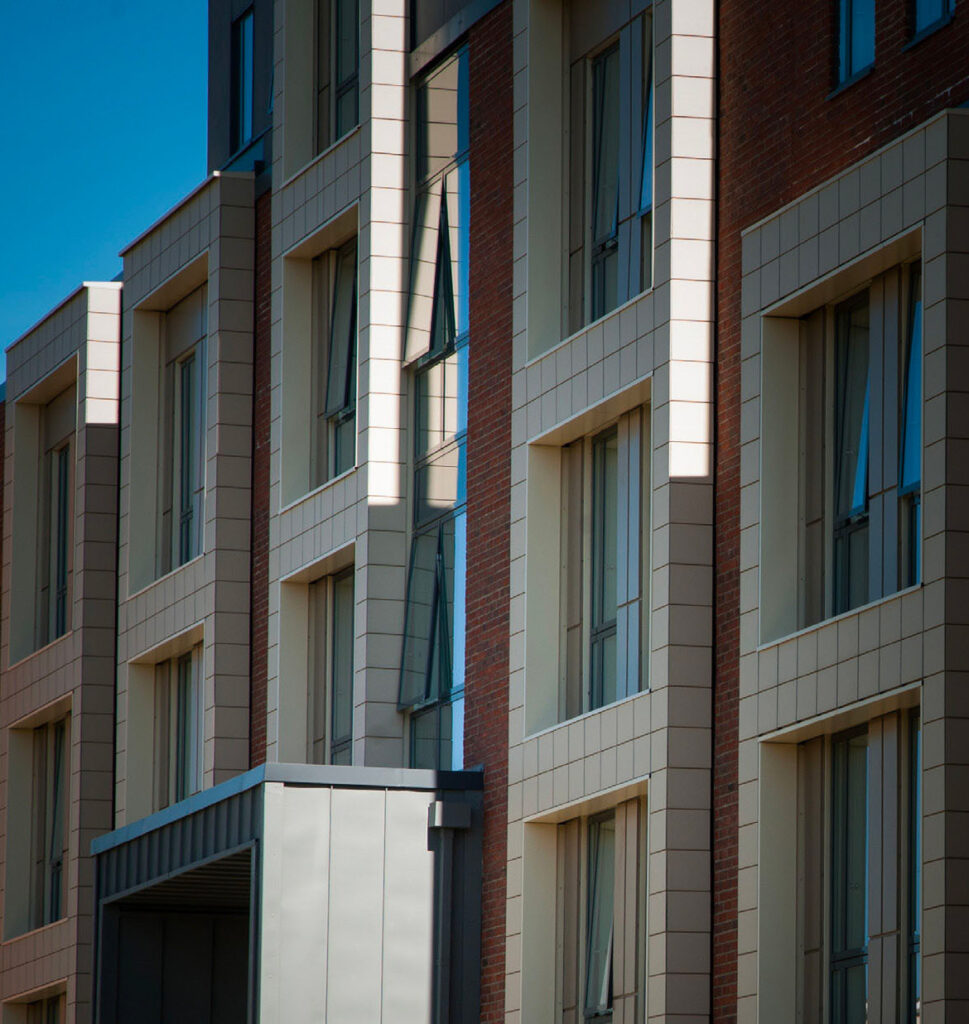
The loss of Sheraton House, which was of moderate heritage significance, was accepted to allow the site to be brought back into full use. A contemporary replacement was designed to enhance the character of the site, complementing Neville House in massing and materials and refreshing the public and external spaces, while also taking into account the scale and proximity of the existing residential buildings.
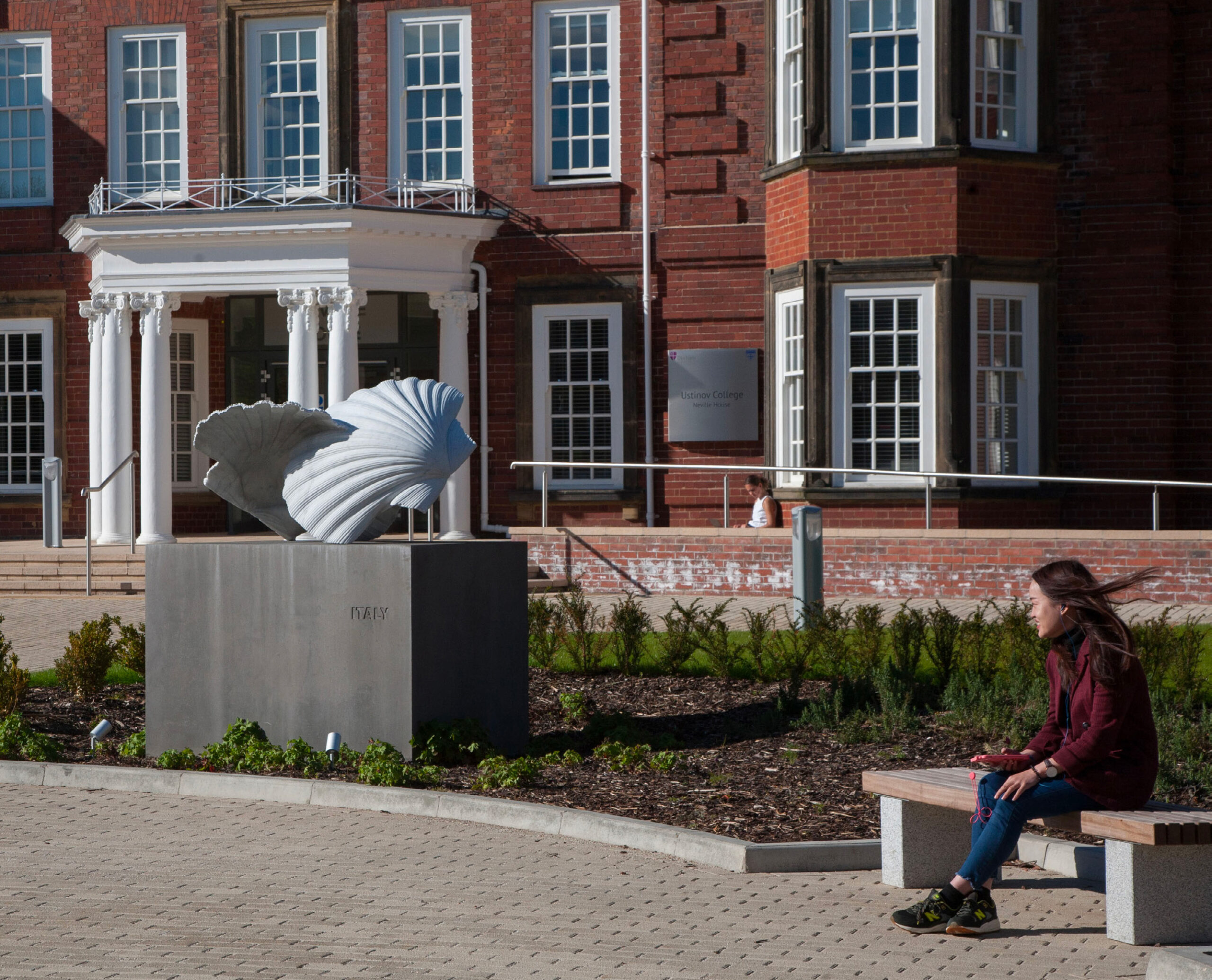
The topography of the site has been transformed with the creation of new public art spaces encouraging shared enjoyment of the parkland setting. A sculpture park with bronze and marble works of art from Italy, China and America are, without doubt, the highlight of the parkland and celebrate Durham as a centre for pilgrims. These sit together with the Sheraton Park Poetry Wall, where the ‘welcome’ poem by Ira Lightman is routed into Corian screens across the ground-floor, with poetry verse on walls and seats
The community had direct involvement with the landscape scheme and could comment on features and finishes. A dedicated community resource space is provided on the ground floor within Neville House, with secure ac- cess. This flexible facility provides a community room with associated storage, kitchenette and accessible toilet and baby change. This provides for a multitude of community activities; a residents association, interest groups, children’s birthday parties etc. University and resident engagement has continued with parent and toddler coffee mornings in the Ustinov Common Room and the post graduates and residents live harmoniously and enjoy the communal spaces.
Public access has also been massively enhanced by the opening up of path- ways and desire lines. The main public space was previously fenced off, and would have been a large private car park had a pre-recession apartment scheme gone ahead. Fortunately this did not happen and the community now benefits from access to this beautiful public realm.
The development also provides cycle parking and a number of Brompton bikes for community and college use. Shared use and ownership of the public spaces and facilities is encouraged.
As part of Alumno’s brief, the design of sustainable spaces was paramount from the outset. Best practice was used in their construction, with the use of Building Information Modelling (BIM) Level 2, allowing for the design process to be successfully managed. The sustainability strategy looked at energy efficient systems to reduce consumption and minimise carbon emissions, using A/A+ rated building elements and taking into account the embedded energy in materials and products, all in line with Durham University’s carbon reduction policy. This collective focus on low environmental impact and sustainability resulted in the building fabric being 20 per cent enhanced above current building regulations.
A range of water saving measures has also been implemented and residents are encouraged to recycle. The new development is aligned closely with Dur- ham University’s green travel policies which promote cycling, walking and the use of public transport.
The long-term prospects for the area are excellent. Ustinov College provides a home for post graduates, forming the first piece in Durham University’s residential strategy for developing their unique collegiate offer. The viability of the site is secured after years of dereliction providing the local community with amazing sculpture and parkland as a shared resource. The vision of the development team lead by Alumno has to be recognised, with the project
taking 6 years to reach fruition. The public spaces created the roots go deep into the heart of the immediate community and postgraduates who now share this amazing place.
Two factors lay at the heart of the Sheraton Park design development; the need for sensitive ‘place making’ and the goal of creating a low environmental impact. Sheraton Park now creates a home for Ustinov College “pilgrims” within the heart of an established community; regenerating a derelict former Edwardian college site left vacant by the recession. A blend of sensitive renovation, alteration and contemporary intervention creates architecture, public spaces, landscape and sculpture of the highest quality to realise the vision for collegiate parkland, for the shared enjoyment of the university students and local residents. The project’s success is testament to team commitment, stakeholder engagement, imagination and creativity
Durham Sheraton Park
Principle of Ustinov College
Ustinov College has about 1600 members, with 410 living at Sheraton Park from 2017. We’ve also had about 400 living down at the original site and by the beginning of the 2018- 19 academic year, totally based here.
When the local residents first saw us coming over the hill about eighteen months ago as the whole idea was mooted they were not all that receptive, but before we moved in we articulated very clearly at a number of resident meetings that these are Post Graduate students. Their motivations and behaviour is very different. The average age is probably around twenty six or twenty seven years old, with many Post Doctorate researchers considerably older than that.
The residents should therefore expect something more than a little different to what they may perceive as student behaviour. Since we moved in September 2017, they have indeed been pleasantly surprised. In fact we’ve put on a number of events to directly engage the community.
We’re living with new neighbours, as they are, and you’ve got to get on with your neighbours. So we’ve been reaching out in a number of ways. The students have been fantastic, putting on some family friendly events like Halloween parties and inviting the local families. Also an art event where twelve very talented students from one of the local high schools contributed work. So we are actively reaching out to our neighbours.
We’re very conscious of our role in the reputational status of the university. A lot of that reputation is related to what the local residents think of us. They could see ambassadors for the university or quite the contrary. I think having this public space is great. Not only do the local residents wander through it, but there is a chance for them to interact with students, even if it’s just, ‘Hello, how you doing?’
I don’t particularly like the expression ‘town and gown’ but it’s often used in Durham and we need to try and address the issue, as I think it does cause division. Because of our physical position we are doing our best to integrate and live as local residents. Ustinov is not only about building globally com-
petent graduates, but also about focusing on how people can develop personally and engage with the wider community. A lot of that we do through our volunteering under the umbrella of our global citizenship programme. It’s obviously not compulsory, but a lot of our students volunteer to reach out into the local communities.
As far as the layout here is concerned, you’ve got a new building and a beautifully restored old building. We like the complementarity of the two. The old and the new. The refurbishment has been done to a very high standard, so everything that needs to be functional in the modern world is brand new, efficient and squeaky clean, but the whole site retains the best of its historic elements. It really is a great achievement.
I think the students are generally very happy with the facilities. The cafe bar was not part of the original plans so we had to go into a negotiation with the developers and the owners about having an extension built, because there was no real interior common space and a bar cafe serves as the emotion- al heart of the college. That’s where students gather. They gather in their kitchens at dinner time, but for socialising they are drawn to the cafe and the bar, so having that facility is extremely important. In some ways these elements make the difference between a straight halls of residence and a college. In the original design there was quite a large courtyard in the centre of the building but we had to push on to that to build the cafe.
The students are starting to build a sense of belonging to Sheraton Park and also the new buildings as a location as well. It’s very, very good, so this has been a great success.
The permanent public art adds to the whole flavour and atmosphere of the place and makes that outside space quite attractive. We’ve also put out some benches in the park, which quickly fill up when the sun blesses us with its presence.
Durham Council has given some funding to student community events. It’s very reassuring that the council really see the value of building community between students and local residents. Sheraton Park has become a symbol of mingling and growing together in this great little city, through consideration and mutual respect. You’ve got to plan ahead to get that across the line. You have to plan to encourage that engagement and interaction. That’s how Alumno saw the space. It was a bold vision, but it’s working.
Durham Sheraton Park
PhD Finance StudentI did my Masters at Durham, so had a reason- ably long association with Ustinov College, then a gap year where I went back home to India to work, before returning for my PhD.
I originally did an undergraduate degree in Engineering back in India. The primary reason I came to the UK was that it gave me a chance to switch to the field that I wanted. I did my Masters specifically in investments and Durham was well known for having an excellent course. Also a daughter of one of my father’s colleagues was an ex-Ustinovian as well. She’s the one who recommended that I come to Durham and that if I come to Durham I should come to Ustinov,. So it’s almost by sheer chance, but I’m so glad it turned out this way.
I’ve absolutely fallen in love with the place. It’s been an ideal setting especially for studies. It doesn’t have too many distractions, but at the same time it gives you the kind of social life you expect in a college setting. Dur- ham is big enough to have a bit of fun, but small enough that you can pretty much walk everywhere.
I go to London to visit, or for conferences and appreciate that it’s a fantastic city, but think I may have found it more of a challenge to build daily human connections. Ustinov is family away from family. You mix happily with every- body, whether it’s the cleaning staff, the management, or friends and col- leagues. When I came to the UK it was my first time living away from home, so there was still a slight fear of the unknown, mixed with excitement. My masters came straight after eight months back in India, working in engineering. I was twenty three at that time so felt a little trepidation when I came to collect the keys for the first time, but the staff made the transition feel as smooth as smooth could be and the whole look, feel and layout of the place just works.
I’m a big fan of cinema, but mainly used to watch Bollywood movies. I came here and people introduced me to all sorts of eras and genres of film making from different countries. It’s been a real eye opener and cultural exchange in much the same way that Matthew describes the sharing of food, in that it prompts wider discussion. I’ve made friends from the rest of the world.
I came here to study, but I’ve also learned things that have contributed to my growth and development as a human. Things I would never have dreamed of, sitting at home, looking at a computer. You can learn a lot from the internet these days, but there’s no substitute for real life experiences. I think my experiences here have helped me understand life a bit better.
MA Modern Literature Student
Durham University
I had a rather broad undergraduate study, in- volving literature, anthropology, history and philosophy. This was in the Netherlands, but on an English programme, as it seemed like the closest thing I could get to these shores, whist not feeling quite ready to move here. I became fascinated with the idea of living where English literature happens at a very early age. A lot of children read ‘The Secret Garden’. I read it a lot.
When I applied for a Masters I had to choose between Oxford, Sussex and Durham. That was a difficult decision to make, but I thought Durham would be a good safe place, with an excellent academic reputation, but a little outside the Oxbridge bubble. After Durham, the plan is to undertake a PhD in Brighton.
I suppose you come to the UK with a particular idea in mind, and you can’t find it, because of course in reality it’s very different. It’s funny how you then find something else that makes you decide to stay. I came with this romanticised idea, based on a lot of literature, and that wasn’t quite what I found but I ended up liking what I did find.
There can be issues, when academic life doesn’t ask us to assimilate as much as we should, or ground ourselves more than just being a student community in the bubble that this provides.
It’s very nice to see everything that happens here, because you are around college staff and international students, but also local teenagers having their first romances in front of your eyes. The surrounding families and their children very much use the park that’s specifically developed for us all to share. One day this very old man came by, carrying his very old dog. Images like that are very touching.
Some people can be a bit reticent at first, but it’s very interesting when they get used to you and greet you. Maybe have a little chat. It’s lovely to establish those kinds of relationships, beyond the general student experience. The way this whole place is designed encourages this mix. I know there was tension to begin with, as people have preconceptions about what living among

Durham Sheraton Park
students might be like, but I find it’s wonderful when it switches and you recognise each other as just another neighbour. This kind of accommodation does encourage that. It would be nice if this model was used more often.
What I am focusing on now and will continue to develop is community con- struction, which is one of the reasons I find this all so fascinating. My idea is to look at working class autobiographies. I want to focus on the power of lit- erature and how the school curriculum and surrounding culture affects this
MA Digital Imaging to Archaeology Student
Durham University
I did my undergraduate in computer science. What drew me to that was the sense of accomplishment you get when you write a pro- gram. It’s almost like solving a problem, a puzzle. It’s something you can see being built. It’s kind of like engineering, even though it’s not.
I grew interested in archaeology when I started working in a local museum. We held several events there. I stared making contacts with the people there and discovered that I really enjoyed working with museum collections.
Through that I started wondering if I could apply the various tools and techniques I was learning from computer science to a museum collection. So I made my dissertation all about the application of digital imaging to museum collections and started getting positive results. It was just a little bit too short.
I decided to approach the archaeology department and told them I wanted to make this in to a more long term research proposal. They had people already working in that domain and needed someone with the relevant software ex- perience, so were willing to bring me on.
I’ve been in Durham since 2016. Part of the reason I came here was because I wanted to live in the UK. I’d visited before. I looked at universities with strong backgrounds in my preferred field. Durham is also in a Unesco World heritage site which swung things for me.
Ustinov college is all post graduate with a high proportion of international students. I found this accommodation online and it seemed like what I was looking for as it was wholly Postgraduates, so older and more mature. I got my undergraduate degree between 1999 and 2004 then worked as a software engineer for about 12 years, before deciding to undertake a Masters degree.
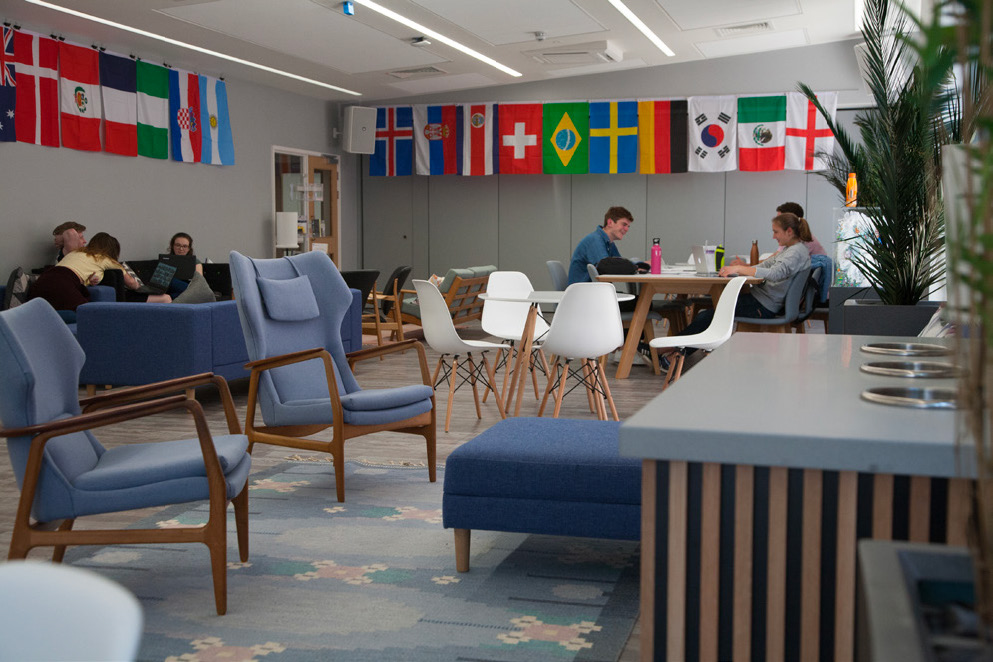
The time I’ve spent here has been one of the most life changing experiences I’ve ever had. It’s a combination of Sheraton Park and Durham as a whole. It’s definitely the fact that Ustinov is an international community. We have
Durham Sheraton Park
so many different students from all round the world. Living and socialising with people from so many different backgrounds and disciplines, creates this very unusual community. I’ve met people from all over the world and made real friendships even in the short time we’ve been together. It’s been an incredible experience.
Last year I shared a flat here. That was also a very good experience. I had flatmates from China, Turkey, Mexico and India, so all of us were coming from different cultures and sharing a kitchen and living space. Cooking together is a great way of breaking down barriers, bonding and opening up discussions about each other’s cultures. We began to get together and share meals. This evolved into us each taking turns making recipes from our home country. People would cook from their food culture, which would open up into discussions about their culture as a whole, as food is so often intertwined and enjoying people’s food is such a primal act of sharing.
This year I got a scholarship and that comes with one of the studio flats. It’s a different experience as I now have my own kitchen, so not the same opportunity to bond over food. Sometimes I miss that. However there are now good common areas in Sheraton Park, building up that sense of community.
Durham Sheraton Park
We use cookies to improve your experience on our site. By using our site, you consent to cookies.
Manage your cookie preferences below:
Essential cookies enable basic functions and are necessary for the proper function of the website.
These cookies are needed for adding comments on this website.