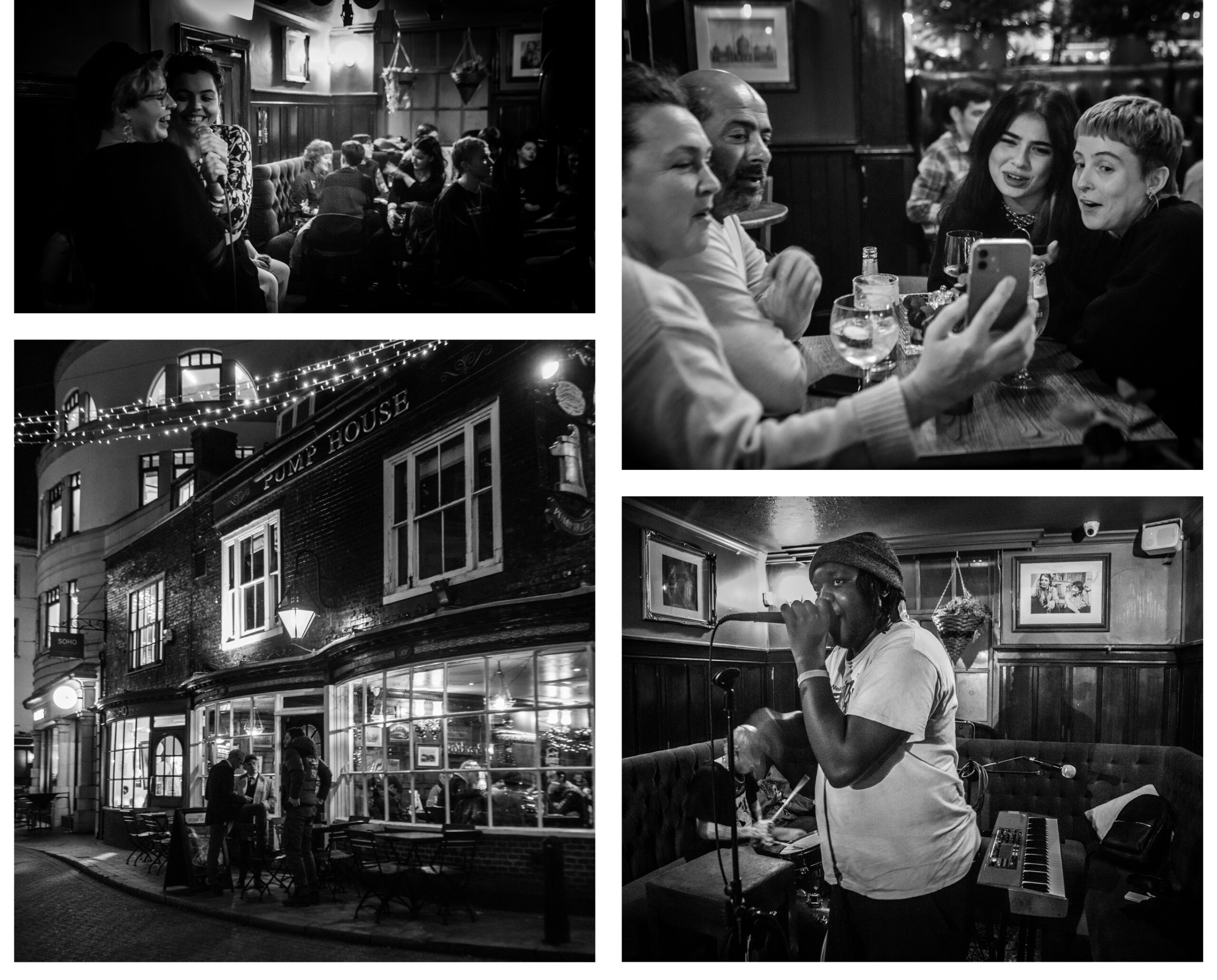
Brighton

Ravilious House

Duncan Greenaway

Architect
Ravilious House

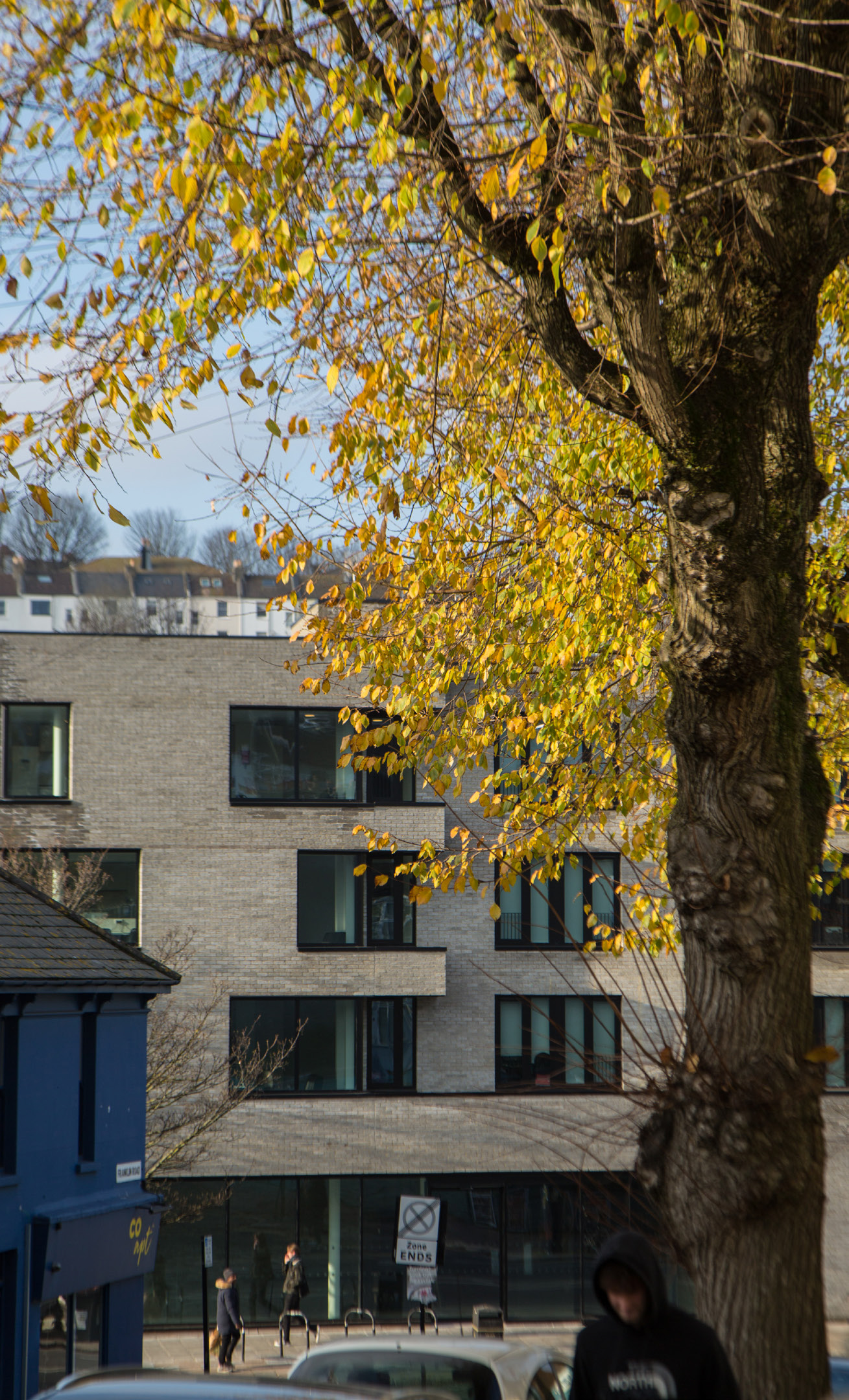
Alumno approached us with this site and asked us to do a concept. We went to look at the site and surrounding areas and it was immediately apparent that the building that was there was a complete misfit. It was a single storey, flat-roofed, unattractive Co-op building with absolutely no relationship to Caledonian Road; a missing jigsaw piece if you like. This was because it had been bombed in the second world war and, in the 1960’s, this building had been thrown up with no due consideration for the context or anything. We’ve commemorated the famous bombing, where many lives were lost, throughout the building.

We did the project in collaboration with the Co-op, who we moved next door where they have a much better unit now. They still have deliveries and things from Caledonian Road, so we maintained the access. That allowed us to retain an active frontage on Lewes Road at ground level, with a lovely artisan bakery cafe unit, but bring the student entrance onto Caledonian Road with its own lovely active frontage.

The new Co-operative is great, so that’s been a bonus for the area. There is demand for artisan cafes and nice places, with lots of creative people there, but the demand wasn’t really being provided for. The lovely artisan bakery cafe on the corner is wonderful for the students, allowing them to integrate with the community. It’s not exclusive, it’s something they share with the public.

We wanted to maximise the footprint of the building because it’s in an important location, and density is appropriate in an urban area. It’s a corner site, so quite important in the urban make-up as it allows us to go slightly higher. Lewes Road needed lifting visually and we set about creating an interesting corner building, which had various different heights. It was lower on the Caledonian Road part, rising up to Lewes Road, and we put student housing in above the retail cafe unit at ground floor.
The site naturally came to a point on the corner, it was an obtuse angle, and that allowed us to make quite a dramatic corner. We accentuated that by having cutaway corner wrap-a-round windows. We put the student com- munal spaces in there, so they had a lovely view up and down Lewes Road. Pushing the corner piece out and setting the main frontage of the building back slightly gives quite a dramatic, dynamic elevation.

Brighton Ravilious House

We also worked with Daylight Sunlight Consulting, and they came up with a purely mathematical scenario which indicated that we had to have cut-outs in certain areas on the solid. When we looked at their model it reminded me of a sculpture by the artist Ben Nicholson that both myself and David Camp- bell have used as inspiration in previous designs. We looked at the site as a solid form and then cut bits away from it, rather how this sculpture by Ben Nicholson was formed. We did it in one material, so it was about the form, one solid block with bits cut out of it.

Cutting away at the ground floor then gave us defensible space for the bed- rooms at that level. We could have planting in front of the bedroom windows,plus huge glass sections spilling light down into the basement that were between the plants. It lends a really interesting frontage at ground floor, and it was always part of the concept to get as much light as we could into the basement. There are forty-two studios, and eighteen en-suite rooms that are connected to fabulous corner kitchen and living spaces.

Whilst we were thinking about Brighton, we were also mindful of another art- ist who we really like called Eric Ravilious. He lived in the area, and worked with sculptors such as Barbara Hepworth and Ben Nicholson – they had the same tutors. He did lovely paintings, including of Brighton, and he utilised these soft, warm, grey tones.

There’s a painting called ‘S.S. Brighton Leaving Newhaven’ and another one called ‘Brighton Queen at Night’, with those tones, and a painting called ‘Shepherd’s Cottage’ which is of Sussex and depicts this lovely, grey flint material. We decided to use a brick that had similar warm pastel grey and reminded us of Eric Ravilious’ work. These two artists inspired the building in tone and its subtracted solid form.

The area itself is in flux, regeneration wise. It’s been slightly scruffy around the edges, that part of Lewes Road, and is in the process of coming up a bit. The area didn’t possess a strong architectural form and style that we could follow. We had the opportunity to give that part of Lewes Road a stronger expression.

We thought Lewes Road deserved better, and this building might become a catalyst for the rest of the road, if we did a good job and created something dynamic, interesting, and well designed. Perhaps inspiring better architec- ture in the local area going forward. Brighton is so hilly that this building needed to be a good three-dimensional form. Not just from the streetscape but from all angles, because with the topography you can see the building from above and at different levels from around the city.

I like the public artwork referencing many of the famous films that were made in Brighton. It feels like it clicks, as not all occupants are film students but there’s a reasonable percentage.

With film light is important and, due to the subtractive structure, there’s a piece cut out of the middle of the Caledonian Road elevation, and these setbacks at the top created a perfect opportunity for amenity space with lots of light and a winter garden. It’s away from the hustle and bustle of the busy street and gives the students a wonderful study and recreational communal space. This peaceful and beautiful view over buildings, churches, and different forms of architecture, with the surrounding hilly aspects of Brighton on the right as you look out the window. It’s a real magnet for people to sit and enjoy.

In pushing the corner out – partly for the structural form – it means that those communal rooms have three dimensions, not double but triple aspect. You get east, west, and south sun in those so they’re light at all times of day, all times of year. We have setbacks at first floor and third floor allowing for greenery at high level, sort of Babylonian terraced gardens. We gave the rooms full-height windows. They stop roughly at seating height, so you maintain a little bit of privacy, but also it gives you a ledge to sit on, to read or study, which is a nice touch, I think.

The insulation is very good. It’s designed to be sustainable and comfortable for the students. The beauty of the high amounts of insulation and thick walls meant that we could have really punched windows, so they feel like cut-outs as well. Part of the sculptural form lies in those punched windows and deep reveals. It creates lovely light and shade on the facade of the building, it’s not a flat facade.

It’s good to balance a design that looks arresting, looks great and fits on the street, but the living experience is still inside – you never want design to be form over function.

As it’s a Film and Screen School the common room is part cinema, and the best place for a cinema – the quietest place and the darkest place – is in the basement. It’s a really cool space, with these windows to the street which connects the student to the street – and vice versa – and brings lovely light in. I love those views through both directions, looking out up to the sky from the basement and, as you’re walking along the pavement, you can see activity in the basement.

The cinema is lovely, with beanbags on the floor. There’s a step in the basement because part of the basement was original and part of it was bombed.

We had these different levels to work with, but it creates this separation in the basement space and the lower ceiling section makes a cosy, intimate cinema. Part of architecture is working with constraints – I think Rem Kool- haas said, “If you don’t like constraints be an artist not an architect.” Rather than seeing these things as problems we see them as opportunities.

We have a very good working relationship with Alumno; with this building Ron Plunz was a great asset, both practically and creatively. He had a lot of positive input with things like creating the overhead ceiling windows in the basement common room.

It’s wonderful taking these schemes from initial first concept sketch right through to finished building and seeing it occupied. I can’t think of a more satisfying job really. It’s such a rewarding process. The only way to get good results from these things is to work collaboratively. I would say that Alumno and Greenaway Architecture even worked well with Brighton Council. We went to see them with a 3D, physical, handmade model, early on to discuss first principles with them. It was a very productive relationship. Everybody was invested in the design, the scheme, and the philosophy behind it.


Brighton Ravilious House

Ian Divall


Accomodation Manager

I run both Ravilious House and Falmer now. Ravilious House is Prestige Student Living. It’s an amazing building and design with lots of very unique things to the building and to Brighton.

It very much feels like you’re part of this com- munity here because the building is in there aligned with the shops, and with the High Street. I live on totally the other side of the city, so this was never anywhere that I necessarily visited. This area of the city – just bang smack outside the city centre – it’s got its own vibe, its own culture, it’s totally different to what I expected it to be.

It’s so handy as well, it’s a very quick bus hop, taxi, or walk to most places. They can walk to the city centre or train station in ten to fifteen minutes. This is an ideal site for student accommodation because it’s close to the Film School, Brighton University Art College, and the main aca- demic campuses.

It’s got a film student feel about it because we worked with the Film School to get something local and relevant. We’ve got a direct connection with the Film School – almost a third of our students study there – we’ve been working with them for over two years.

It’s great that we’ve also incorporated the film-related artwork. I’ve lived in Brighton for 30 years; I didn’t realise some of these films were filmed here. The famous ones are Quadrophenia and Brighton Rock. I didn’t realise that Tarzan and Jane was filmed in Brighton rather than somewhere exotic!

I have my assistant accommodation manager Grace here. A brilliant thing about Grace is she studied at the Film School, and at an American version of Film School. So, she’s completely got what the students want or need, because she’s been in their shoes and studied in the same place.

It’s a nice setting and this place feels good to run. Now that we’ve got the public communal space given to us, we can make it ours. We can work with the students to make this their social environment.

You’ve got two different communal environments. The rooftop terrace, which is more naturally a quiet place, and then you’ve got downstairs which is more of a sociable space really – with the pool table and the cinema room.

The security is good. Access into the building is only by student key. Even if you sneak in the front door, you can’t get anywhere else anyway. You can’t use the lift without a key or get through the fire doors and interconnecting corridor doors.

Relationships are what it’s all about. I worked with Ron Plunz, and Alumno, on a previous project one-to-one and I think we’ve both learned from each other over the two projects. I feel happier about running this place when I’ve had such a close relationship with the developer. After the other project, I know what the expectation is from the developer and how they work. A lot of the input has been very mutual, you know, it’s not a case of, “We’re going to do this” it’s, “Ian what do you think?”

‘It very much feels like you’re part of this community here because the building is in there aligned with the shops, and with the High Street’.

Ron has a huge attention to detail with great design sense. The large communal space downstairs is very much Ron’s doing. Ron was involved with this idea of the natural lighting. It’s the benefit of him also being a trained architect. The unique downlighters, as I suppose they’re called, which use the glass floor on the ground floor level. In the summer, the sun can shine in for pretty much sixteen hours a day. It makes a massive difference to the environment down there.

The working relationship means I’ve been able to feel a lot more confident to say, “No, I don’t think that’s quite right, can we think about doing it this way?” Even small things like the pool table; it’s in the wrong place accord- ing to the drawings, but it’s in the right place because it works where it is.

Where it was going to be, in the cinema, it wasn’t going to fit properly for the movement of the pool cues. We literally took the lid off the box, took it in there, and laid it out in all sorts of different positions to prove it was going to be far too tight. Now, it feels more socially part of this space, people can play pool but maybe interact more. It would have been noisy if they were watching a movie.

The big opening event was the unveiling of the commemorative plaque for those that sadly lost their lives in a bombing in 1940. There were forty or fifty people from the major and relevant associated community groups and members of the public. The breakfast bar area is ideal for such events, and we use it for the students. It gives us a platform to work with, so to speak, for the food plus giveaways and stuff like that.

We’ve got quite a mix staying here, we’ve got Film School, Brighton Uni, and Sussex Uni. Although quite a large percentage of students are from the UK, we’ve also got some East Asian, Indian, and African students, as well as some from continental Europe.

It’s all about student experience and next year’s students will have different demands and requirements, so we’ll have to adapt. I have a very bespoke attitude. I always get to know everybody; then they feel comfortable they can come to you and that you’ll help them. That’s the benefit of not being a great big place. It’s my responsibility for the students I’ve got with me – their parents give them to me to look after for a year or maybe more – and I do it with pride. We’ve had to teach people to use a washing machine, different things like that, because that’s what is required.

It really is an amazing space, and you can feel all the effort that everyone has put in to create this. Obviously, it’s hard work and it’s the first lot of stu- dents. It’s quite a balancing act to get something that’s new to be right for the students and their expectations. But we’re working on it, we’ll keep working on it, and move with it.

Brighton Ravilious House

Andrew Halajian

Business Management Student

University of Brighton

I come from Lebanese-Armenian ethnicity, but I was born and raised in Ghana, West Africa, were some of my family for five generations. I wanted to study in the UK and The University of Brighton has got a very good reputation for Business Management, with the added bonus of being in a great city, which even has its own beach, but also really handy for London.

I hadn’t been to the UK before, even though I’ve got British citizenship through my mum, who comes every year. I think that’s why I’ve got a Scottish name.

I’m eighteen, so it’s all a new adventure and thankfully I’m finding Brighton to be even better than I’d expected. I didn’t expect it to be this culturally open. I worried I would feel like the only foreigner and maybe out of place, but quick- ly found all kinds of people I could relate to. It’s a very cosmopolitan place, with lots of things to do in Brighton and the nightlife is great.

I wanted to find somewhere to stay where I would feel comfortable be- cause I’ve never lived alone before. When I did my research online, I saw Ravilious House and immediately liked it. This place makes me feel open.

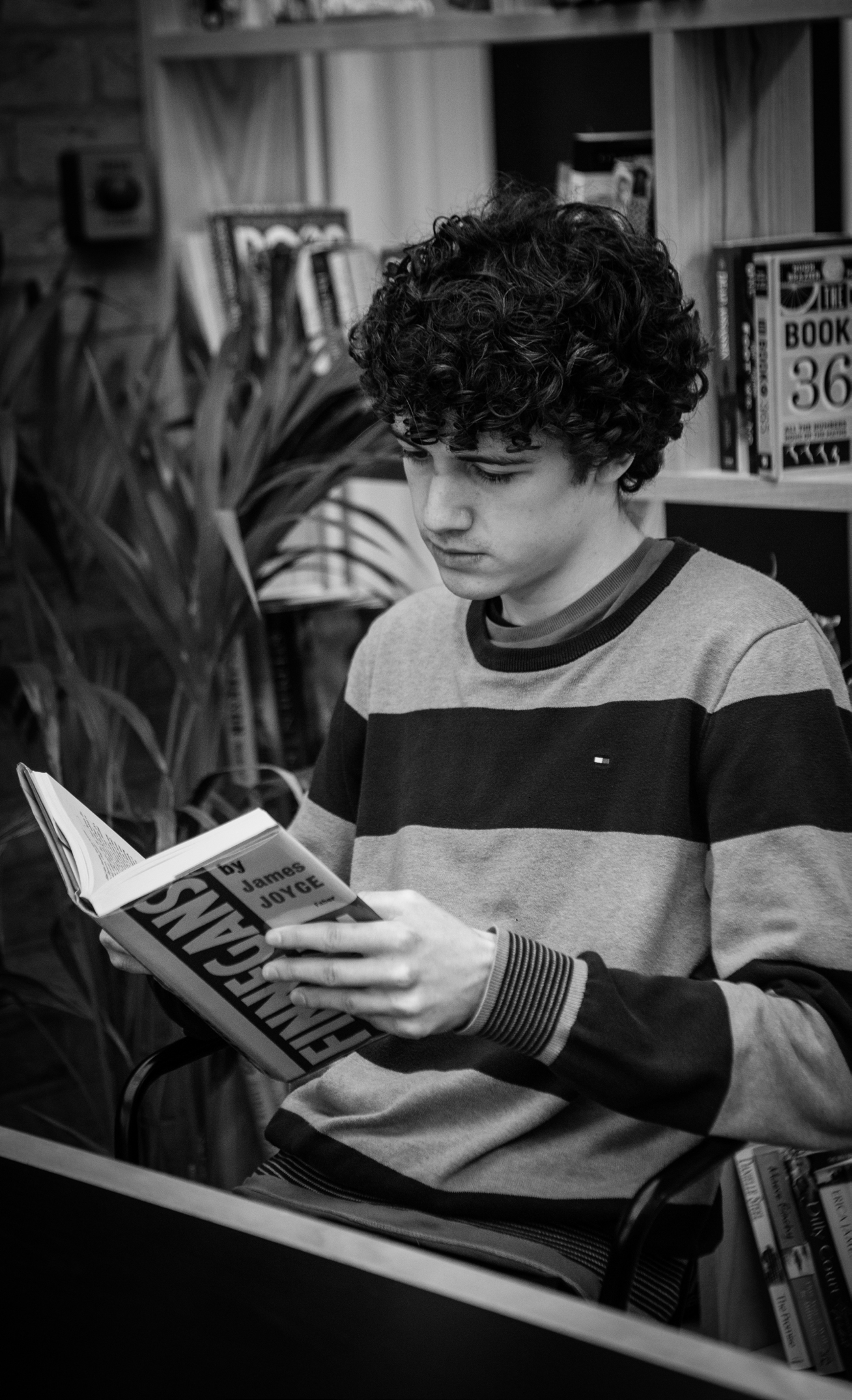
I wanted a studio, and they are really nice here. The design of the whole place is beautiful and modern. I like how they have books everywhere to show the education side of it. The upstairs common room especially feels like it’s almost like an extension of the university. I like to socialise with friends in the downstairs common room. If visitors from the University come we can play pool and stuff, but I usually go upstairs to study because it’s quieter, on the terrace.

My Mum is an interior architect. I’ve been lucky enough to grow up surround- ed by good design. I’m quite intrigued by it, so I really like living in a place that’s so beautifully designed.

There’s a lot of attention to detail. The flats have made excellent use of the space. It’s good having the LED lights in the kitchen and at the desk as well, so you don’t need a lamp. There are lots of bookshelves and storage areas
It’s like a blank canvas and you can put your own touches to make it personal for you. The bathroom is exactly everything you need. It’s perfect.

I love it when it’s raining on the upstairs terrace. If I go up there to study it’s a bonus if it rains. It’s really soothing. British people always complain about the rain but they’re actually lucky.

The downstairs common room is great too. I know someone from the second floor here. We bring his PS5 down here, play some games, invite some friends over or just chill in the cinema room. I like that it’s just casual, there’s no booking. In other accommodations if you need to bring a friend over you have to sign them in and all that. Here, I’m more free. It’s like a home rather than living in some organised place. The management are great. Ian is very nice, anything I need or ask for, straight away it’s done. I think I’ll stay in this accommodation for longer than the first year – I’m very comfortable with it. My cousin from Ghana might be coming here. If he does, we might get a shared house or something, but if not I’ll just stay here.

I’m enjoying my business management course. When it comes to business I’ve been interested since I was sixteen. I’ve tried a lot of stuff in Ghana. Right now, I’m currently running an app with my cousins in Ghana. You know how there’s often a ticketing app for clubs, when they have events that you want to buy? Ghana’s a developing country so it hasn’t reached there. We thought that we could do that, and we’ve been working on it since. Nightlife in Accra is wonderful. Our plan is to organise it even better to make the systems work more smoothly. I even had to go and meet with club owners at eighteen and present our offer, how it works, and would they sign with us – and they did. Thanks to modern technology, I’m here studying in Brighton but can still work with business ideas wherever in the world, including back in Ghana.

I think the degree’s going to be very useful in my future. I have three years to finish. I would like to do a master’s but maybe somewhere in London. I want to gain some work experience in the UK. Hopefully I would like to start a business in Ghana. I see it as a developing country and there’s a lot of room for growth. I’ll make all sorts of connections here as well, not just academic, but international connections for business, ideas and everything as well.

I’m an afro-beats kind of person, and a South African genre called amapi- ano. The uni has an Afro-Caribbean Society; they throw parties now and then. It’s really nice when you attend them, because you meet a lot of people who also listen to the kind of music you like. I go to PRYZM, and the DJs are very good, they mix afro-beats, putting one or two songs in there which is fine by me. I’m expanding my music knowledge by being here as well.

Dylan Gouldthorpe

Film Studen
Brighton Screen and Film School

I’m from High Holden in Kent, which is only about one and a half hours from Brighton.

I came to Brighton because I wanted to go to the Film School. I liked the look of all the modules, it seemed there was a lot of practical work, and I just like Brighton as a place. We’d been a few times just to look round and it all meshed well; it’s a good school that seemed like a good fit and Brighton’s great.

We knew this accommodation was still under construction, but it caught my eye and it’s linked to the Film School. Most of my flatmates go to the same school. We each have an en-suite but there’s one communal kitchen for six of us. There’s one person who is from abroad and she doesn’t go to the Film School. She’s in her third year but decided to stay in this accommodation because she could focus well here and get more work done.

The design of this place works really well for me. My en-suite and overall flat are great, and I like using the common areas. It’s kind of a nice change of scene from my room. I come down with friends and can do some work or use the pool table.

I’m not sure if I would stay in the UK. We lived in New Zealand from when I was five until I was eleven. Obviously, we went to where Lord of the Rings was shot which was really cool for a child. We’ve been to other places around the world on holiday and there’s definitely places I’d like to experience more of.

I’m eighteen and only in my first year, so still evaluating which area I’ll focus on. I love film as a medium and enjoy the script writing part of it. I like writing prose and other forms of writing as well. You can sort of take in any aspects as long as you do it well. It just requires an understanding; a first-hand expe- rience is obviously best, but that kind of stuff can be learned. I can see my future going in that direction.

Brighton Ravilious House

Mia Lana Cameron

Film Student

University of Brighton

I’m at Screen & Film School, Brighton. It’s not the film department of the main Brighton University, it’s a separate university just for film. So many people in my year are eighteen or nineteen. I’m feeling old, cos everyone in my class is like, “How old are you?” and when I say I’m twenty they go, “Oh my god!”

We are quite an arts kind of family I suppose; either professionals in the creative industries or involved in making art in some way. My Dad, Papa, and sister love photography. There were film editors in previous generations of my family and my Grandad was a props maker. Despite there being a lot of film in my family I’d say it was coincidental to me being here. It was never actually talked about, until after I decided to study it.

I decided to take film because I love classic literature like Jane Austen and Shakespeare and I wanted, one day, to make adaptations. We all have different ways of interpreting things, but when I have seen adaptations of films – even from quite a young age – I would always think that’s not how I would do it.

I began film studies back at school and decided to do it at uni. I used to want to be a writer. I’d read more books than watch films, but as I read I would have a whole movie in my head. I knew exactly how I’d make it, how I’d translate the words – what I’d put in and what I’d take away. It’s been an instinct since I was about fourteen, when I really started getting into classic literature. My granny’s favourite book was ‘Pride & Prejudice’ so when she died, I read it and thought it was amazing!

My flat is a mix of people: there’s someone doing Maths, someone doing Management for Construction, and someone’s studying Law. They’re all from the British Isles. One guy is from Scotland and there are people from different parts of England and cultural heritage. I’m originally from Scotland too, I moved down to South Hertfordshire when I was a young child. I’ve always known Scotland as part of my life; any hint of a school holiday and we’d be up.

I really like this building, especially the communal areas downstairs and up- stairs. We have been going to the third floor during the day. Sometimes we all
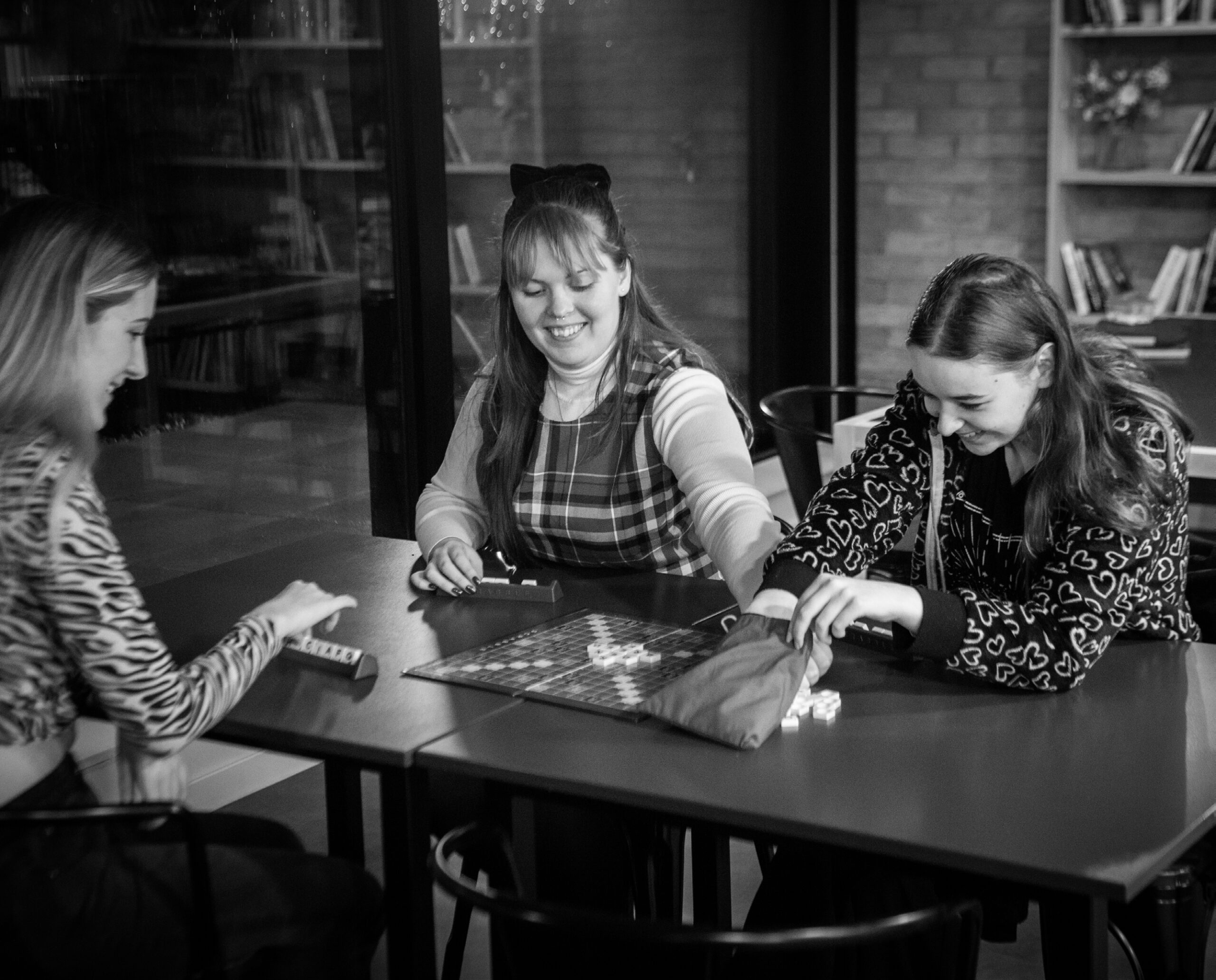
go downstairs, often just playing board games and hanging out, though they are good working spaces too. It’s nice to have somewhere to go to hang out, and meet other people, that isn’t the kitchen of our flat.

I really do like that there’s this connection with the course. I saw on the leaf- let, when I first signed up to live here, that film students were involved in the design, and it would have a film theme. That was part of what influenced me to come here. I think it’s a cool concept to live in a place that is part of your uni course as well, it feels really specific. When you come in you see the art- work with all the films that were made in Brighton. The concept runs through everything including having a cinema room.

Since I’ve moved here and started uni, I’ve been so busy so it’s difficult to go to the theatre. If I were to go to the theatre I would usually go in London, because then I can meet up with my family and friends from home since it’s halfway in between.

A lot of people living and working in Brighton are involved in theatre in a big way. That theatrical culture is very much part of Brighton. I like that it’s an artsy place, especially compared to where I lived before in Hertfordshire be- cause that’s like a village. My sister used to hang around the nearest town when she was a teenager, so she was quite chavvy. Then she took Photogra- phy at university, and turned into this huge rainbow of art. Where all her old friends were in their tracksuits with orange makeup she was looking like Pink- ie Pie from My Little Pony.

I’m at the beginning of a three-year degree. I think my end goal is maybe to be a film director, but I don’t mind doing other stuff. I like working on lighting and script writing. I was thinking about going into theatre briefly after uni as well, just because I really do like plays. That’s leaning more into English Literature than it is to film, but they still correlate and require the same techniques.

Brighton Ravilious House

Brighton Ravilious House